The Hidden CRM Problems AI SDRs Expose
This blog explains how AI SDRs expose hidden CRM problems.
Ramya S.
May 29, 2026
Generative AI
Sales
CRM
Sales Team
Productivity
Generative AI
Inside Sales
Sales Acceleration
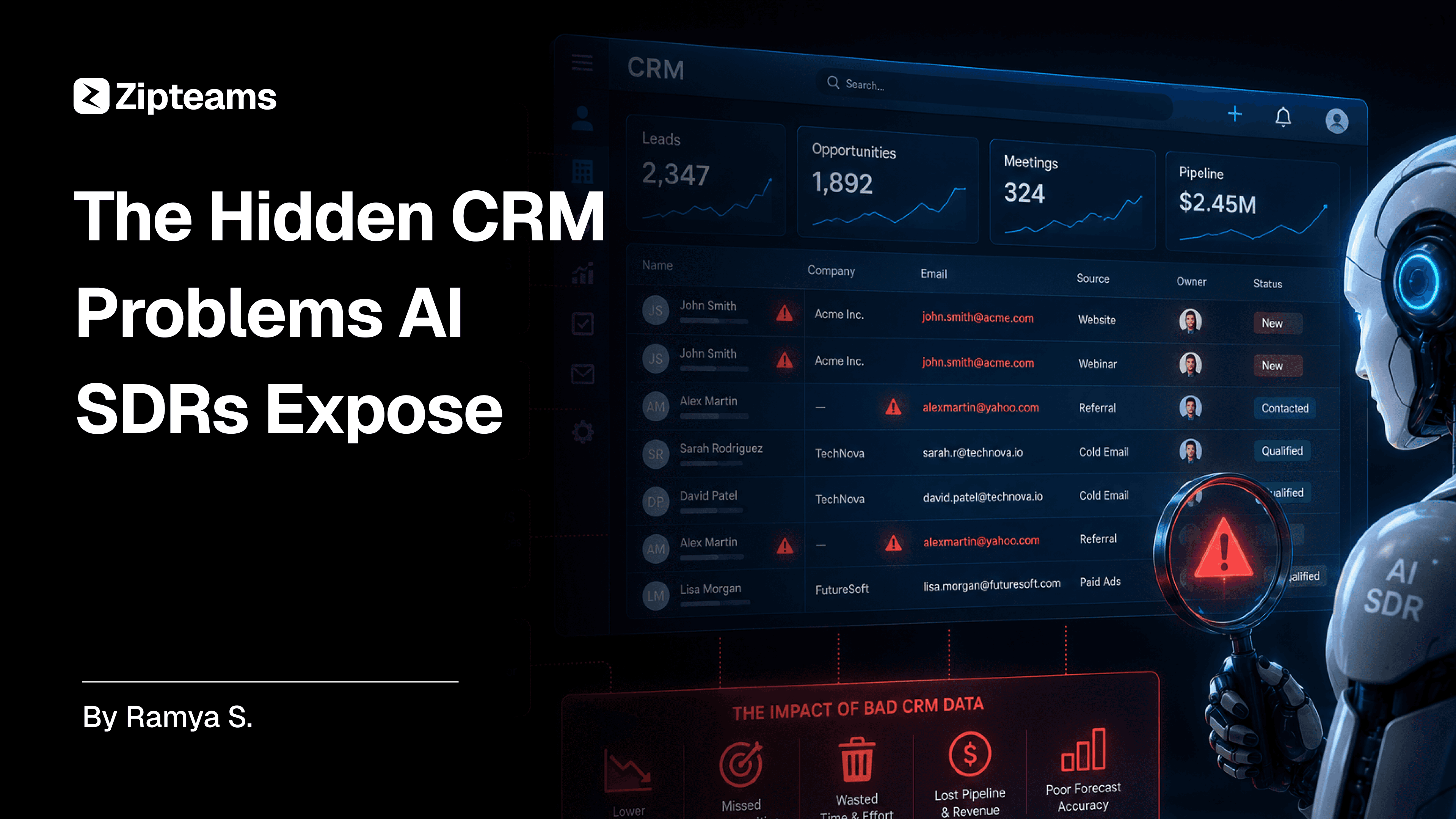
Most companies believe their CRM is functioning properly until they deploy an AI SDR.
Suddenly, hidden operational issues become impossible to ignore:
incomplete lead records
duplicate contacts
broken lifecycle stages
outdated qualification logic
missing conversation history
disconnected buyer context
Human SDRs often work around these problems manually.
AI SDRs cannot.
This is why many organizations discover that their biggest sales bottleneck is not outreach — it is CRM quality.
What Happens When AI SDRs Depend on Bad CRM Data
AI SDRs rely on structured, accurate, real-time information to operate effectively.
Modern AI SDR systems use CRM data to:
personalize conversations
prioritize leads
qualify prospects
trigger follow-ups
detect buying intent
route opportunities
If the CRM contains inaccurate or fragmented information, AI performance declines immediately.
This exposes operational weaknesses that human teams previously compensated for manually.
Problem #1: Incomplete Lead Data
Many CRMs contain partially filled records.
Common examples include:
missing job titles
outdated emails
incomplete company information
missing industry data
no buying context
Human SDRs often fill gaps through manual research.
AI SDRs depend on clean data to generate relevant outreach.
Without proper context, the result is:
generic messaging
poor personalization
lower engagement rates
inaccurate qualification
This is one of the first CRM issues AI SDRs expose.
Problem #2: Duplicate Contacts and Accounts
Duplicate records create major problems for AI SDR systems.
A human rep may notice duplicates manually.
AI systems process every record independently.
This can lead to:
duplicate outreach
inconsistent ownership
fragmented engagement history
inaccurate lead scoring
poor buyer experiences
As AI SDR adoption grows, CRM deduplication becomes critical infrastructure.
Problem #3: Broken Lifecycle Stages
Many lifecycle stages no longer reflect real buyer journeys.
Examples include:
MQLs that were never contacted
SQLs without qualification
closed-lost leads still receiving campaigns
opportunities missing decision-makers
AI SDRs use lifecycle stages to decide:
who should receive outreach
when follow-ups should happen
how aggressively to qualify
which leads deserve prioritization
Broken stages create broken automation.
This often reveals deeper RevOps issues inside GTM workflows.
Problem #4: Missing Conversation Context
Modern sales conversations happen across:
email
calls
LinkedIn
chat
meetings
website interactions
Most CRMs are designed as databases, not conversation systems.
As a result:
buyer history becomes fragmented
objections get lost
context disappears between teams
AI systems lack continuity
Human SDRs sometimes reconstruct context manually.
AI systems struggle when conversation intelligence is missing.
This is why conversational memory is becoming a core requirement for AI-first revenue teams.
Problem #5: Outdated Qualification Logic
Traditional lead scoring systems were built for older sales models.
Many still rely heavily on:
company size
industry
job title
form fills
But modern buying intent is behavioral.
AI SDRs analyze:
urgency signals
stakeholder involvement
sentiment shifts
engagement patterns
technical evaluation behavior
This exposes how outdated many CRM qualification systems have become.
Why AI SDRs Expose Revenue Bottlenecks
AI SDRs act as operational diagnostic systems.
They reveal:
slow response times
broken workflows
missing ownership
poor routing logic
inconsistent follow-ups
weak enrichment systems
In many organizations, AI adoption becomes the first time revenue leaders see how fragmented their GTM infrastructure actually is.
What AI-First CRM Systems Will Look Like
The future CRM will not function as a static database.
AI-first CRM systems will become:
conversation intelligence layers
real-time intent systems
contextual memory engines
autonomous workflow coordinators
Instead of storing records passively, future CRM platforms will actively support revenue execution.
AI SDRs are accelerating this transformation.
How to Prepare Your CRM for AI SDRs
Companies preparing for AI SDR adoption should focus on:
CRM deduplication
lifecycle cleanup
enrichment quality
centralized conversation history
accurate ownership rules
real-time integrations
The better the data foundation, the better the AI SDR performance.
Key Takeaways
AI SDRs expose hidden CRM inefficiencies quickly
Poor CRM data reduces AI SDR performance significantly
Duplicate records and broken lifecycle stages damage buyer experience
AI SDRs require structured, contextual, real-time data
Modern CRM systems are evolving into conversational revenue infrastructure
Frequently Asked Questions
Why do AI SDRs expose CRM problems?
AI SDRs depend heavily on structured, accurate data to operate effectively. Human teams often compensate for CRM issues manually, while AI systems cannot.
What CRM problems affect AI SDR performance most?
The biggest issues include incomplete lead data, duplicate records, broken lifecycle stages, and missing conversation context.
Can AI SDRs improve CRM quality?
Yes. AI SDRs can identify inconsistencies, missing data, workflow gaps, and operational bottlenecks faster than traditional sales processes.
What kind of CRM works best for AI SDRs?
AI SDRs perform best with CRMs that support real-time integrations, conversation history, clean data structures, and dynamic workflow automation.
Are AI SDRs replacing CRMs?
No. AI SDRs are evolving CRMs from static record systems into intelligent revenue infrastructure.