Start your first month free! Get 5,000 credits to put ZIP to work.
Sign up free
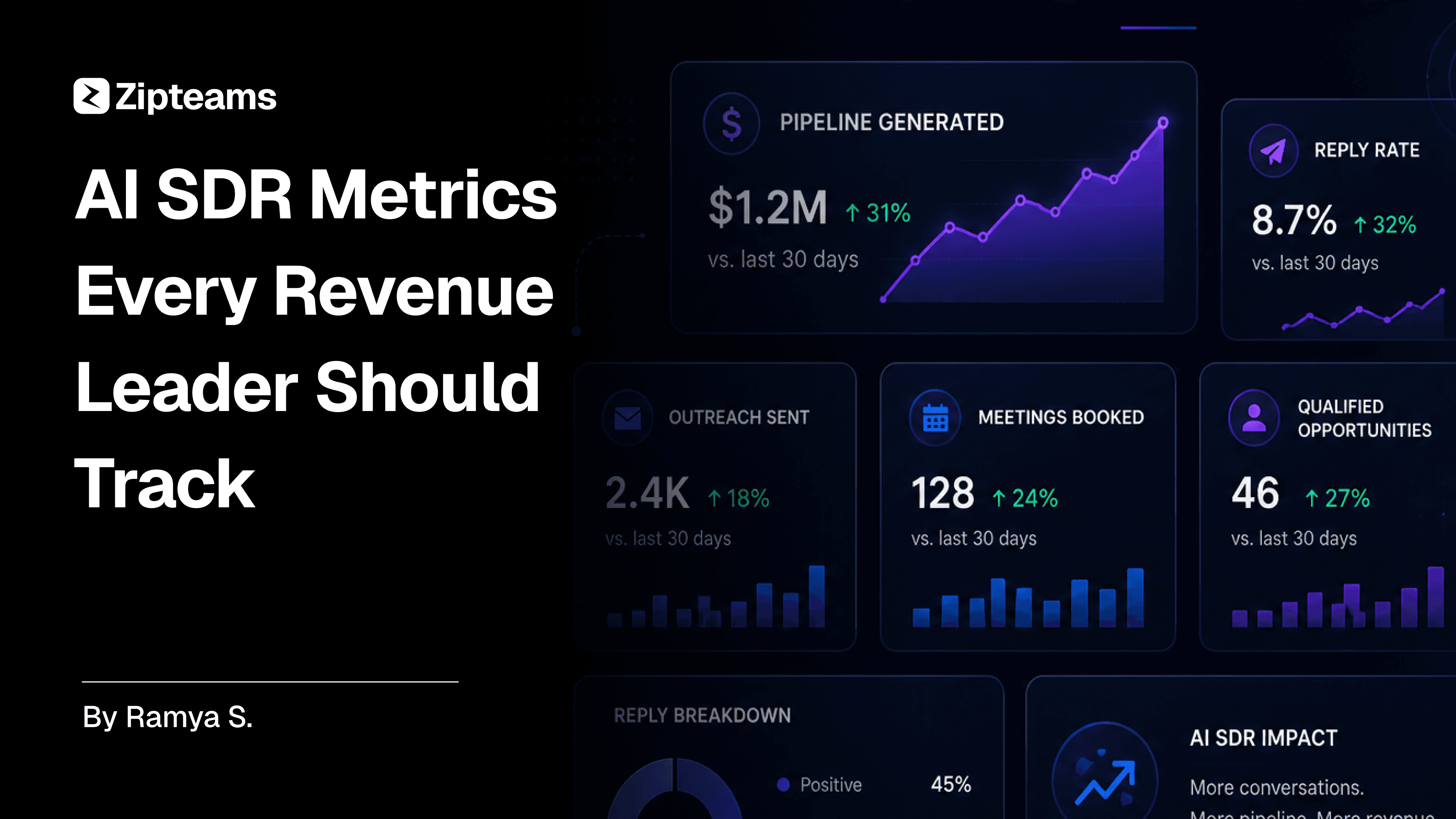
AI SDR Metrics Every Revenue Leader Should Track
This guide breaks down the key AI SDR metrics every revenue leader should track, what they mean, and how top-performing teams use them to improve results.
Ramya S.
Generative AI
CRM
Meeting Room
Generative AI
In 2026, implementing an AI SDR is no longer the difficult part.
The real challenge is measuring whether it's actually working.
Many revenue teams make the mistake of tracking activity metrics—messages sent, conversations started, or leads engaged. While these numbers may look impressive, they don't tell you whether your AI SDR is creating pipeline or driving revenue.
So which metrics actually matter?
This guide breaks down the key AI SDR metrics every revenue leader should track, what they mean, and how top-performing teams use them to improve results.
What Are AI SDR Metrics?
AI SDR metrics are the performance indicators used to measure how effectively an AI SDR engages, qualifies, and converts leads into pipeline opportunities.
These metrics help answer questions such as:
Is the AI engaging leads quickly enough?
Are conversations turning into meetings?
Is pipeline quality improving?
Is the AI generating positive ROI?
The goal isn't to measure activity.
The goal is to measure revenue impact.
Why Traditional SDR Metrics Are No Longer Enough
Historically, SDR teams tracked:
Calls made
Emails sent
Connect rates
Daily activity volume
AI changes the equation.
An AI SDR can engage thousands of leads simultaneously.
Because activity is virtually unlimited, revenue leaders must focus on outcomes instead.
The 10 AI SDR Metrics That Matter Most
Metric 1: Speed-to-Lead
This measures how quickly a lead receives the first response after showing intent.
Examples:
Form submission
Demo request
Pricing page visit
Chat initiation
Why It Matters
Buyer intent has a short shelf life.
The faster the response, the higher the likelihood of engagement.
Benchmark
Best-in-class: Under 60 seconds
Good: Under 5 minutes
Poor: Over 30 minutes
Metric 2: Lead Engagement Rate
Measures the percentage of leads that actively engage after initial outreach.
Formula:
Lead Engagement Rate = Engaged Leads ÷ Total Leads
Why It Matters
This shows whether your messaging and targeting are working.
Metric 3: Qualification Rate
Measures how many engaged leads meet your ICP criteria.
Formula:
Qualified Leads ÷ Engaged Leads
Why It Matters
High engagement means nothing if the leads aren't qualified.
Metric 4: Meeting Booking Rate
Measures how effectively the AI converts qualified conversations into meetings.
Formula:
Meetings Booked ÷ Qualified Leads
This is often the most important operational metric.
Metric 5: Lead-to-Meeting Conversion Rate
Measures end-to-end efficiency.
Formula:
Meetings Booked ÷ Total Leads
This is one of the clearest indicators of AI SDR performance.
Metric 6: Conversation Completion Rate
Measures how many conversations reach a meaningful outcome.
Outcomes include:
Qualification
Disqualification
Meeting booked
Why It Matters
It identifies conversation drop-offs.
Metric 7: Objection Recovery Rate
Measures how often the AI successfully continues a conversation after receiving pushback.
Examples:
"Not interested"
"Too expensive"
"Not the right time"
Why It Matters
Some of the best opportunities initially say no.
Metric 8: Pipeline Generated
Measures total pipeline value influenced by the AI SDR.
Formula:
Total Opportunity Value Created
Revenue leaders should care more about this than activity metrics.
Metric 9: Cost Per Qualified Meeting
Formula:
AI SDR Cost ÷ Qualified Meetings Generated
This allows direct comparison against human SDR teams.
Metric 10: AI SDR ROI
Formula:
Pipeline Generated ÷ AI SDR Investment
This is ultimately the metric executives care about most.
How High-Performing Teams Build AI SDR Dashboards
The best dashboards focus on three categories:
Efficiency Metrics
Speed-to-lead
Engagement rate
Completion rate
Conversion Metrics
Qualification rate
Meeting booking rate
Lead-to-meeting rate
Revenue Metrics
Pipeline generated
Cost per meeting
ROI
Common Mistakes When Measuring AI SDR Performance
Measuring Activity Instead of Outcomes
Messages sent don't create revenue.
Pipeline does.
Looking Only at Meeting Volume
More meetings aren't always better.
Meeting quality matters.
Ignoring Qualification Quality
An AI SDR that books unqualified meetings creates work, not value.
Frequently Asked Questions
What is the most important AI SDR metric?
For most companies, Lead-to-Meeting Conversion Rate is the clearest measure of effectiveness.
How do you measure AI SDR ROI?
Compare pipeline generated against the total cost of the AI SDR platform.
Should AI SDR metrics differ from human SDR metrics?
Yes. AI removes activity constraints, making conversion and revenue metrics more important.
Final Thoughts
The future of AI SDR measurement isn't about tracking more data.
It's about tracking the right data.
The companies seeing the highest returns aren't obsessed with messages sent or conversations started.
They're focused on pipeline, conversion efficiency, and revenue impact.
Because ultimately, an AI SDR isn't a productivity tool.
It's a pipeline generation system.