Start your first month free! Get 5,000 credits to put ZIP to work.
Sign up free
AI SDR vs Human SDR: What Actually Performs Better in 2026?
This guide breaks down exactly how AI SDRs and human SDRs compare, where each performs best, and why the highest-performing sales teams are increasingly combining both.
Ramya S.
B2B Sales
Sales
CRM
In 2023, most B2B companies relied almost entirely on human SDRs to generate pipeline. SDR teams spent their days responding to inbound leads, prospecting accounts, sending follow-up emails, qualifying opportunities, and booking meetings for Account Executives.
By 2026, the landscape looks very different.
AI SDRs can now engage leads instantly, hold natural conversations, qualify prospects, handle common objections, follow up automatically, and schedule meetings without human involvement.
As a result, revenue leaders are increasingly asking:
Should we hire more SDRs or invest in AI SDRs?
It's a reasonable question. After all, both are designed to accomplish the same goal: turning interest into pipeline.
But the answer isn't as simple as declaring one winner.
AI SDRs and human SDRs excel in different areas. Understanding those differences is critical for building an effective sales organization in 2026.
This guide breaks down exactly how AI SDRs and human SDRs compare, where each performs best, and why the highest-performing sales teams are increasingly combining both.
What Is an AI SDR?
An AI SDR (Artificial Intelligence Sales Development Representative) is a software system that automates many of the responsibilities traditionally handled by human SDRs.
Using large language models (LLMs), CRM data, behavioral signals, and workflow automation, AI SDRs can:
Engage inbound leads instantly
Respond to website visitors
Qualify prospects through conversation
Ask discovery questions
Handle common objections
Follow up automatically
Schedule meetings
Update CRM records
Unlike traditional chatbots, modern AI SDRs are designed around revenue generation rather than simple customer support.
Their primary objective is to move prospects through the top and middle of the funnel.
What Is a Human SDR?
A Human SDR (Sales Development Representative) is responsible for identifying, engaging, and qualifying prospects before handing opportunities to an Account Executive.
Typical responsibilities include:
Responding to inbound leads
Conducting outbound prospecting
Qualifying opportunities
Managing follow-ups
Booking meetings
Updating CRM records
Human SDRs contribute capabilities that technology still struggles to replicate consistently:
Emotional intelligence
Relationship-building
Strategic thinking
Creative problem-solving
Complex conversation management
For years, these strengths made human SDRs the standard approach for sales development.
Today, AI is beginning to challenge that model.
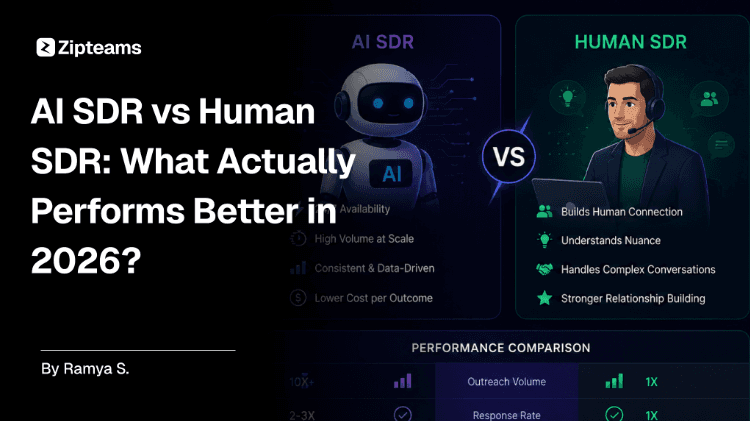
AI SDR vs Human SDR: Quick Comparison
Factor | Human SDR | AI SDR |
|---|---|---|
Availability | Business hours | 24/7 |
Response Time | Minutes to hours | Seconds |
Lead Capacity | 50–100/day | Thousands simultaneously |
Follow-Up Consistency | Variable | Consistent |
Cost Scaling | Requires hiring | Scales efficiently |
Relationship Building | Excellent | Limited |
Emotional Intelligence | Strong | Weak |
Technical Discovery | Strong | Moderate |
Meeting Scheduling | Manual effort | Automated |
Global Coverage | Limited | Continuous |
Ramp Time | Weeks or months | Immediate |
Enterprise Sales | Strong | Limited |
At first glance, AI appears to have a clear operational advantage.
But operational efficiency isn't the entire story.
To understand what actually performs better, we need to evaluate each stage of the sales process.
How AI SDRs and Human SDRs Perform Across the Funnel
Top of Funnel (TOFU)
This is where prospects first engage with your business.
Activities include:
Website visits
Form submissions
Demo requests
Outbound responses
AI SDR Performance
AI SDRs excel here.
Why?
Because speed matters.
The moment a prospect submits a form or visits a pricing page, the AI can respond immediately.
There are no delays caused by:
Meetings
Time zones
Work schedules
Lead queues
Every lead receives immediate attention.
Human SDR Performance
Human SDRs face natural limitations.
Even great teams cannot respond instantly to every lead.
Leads often wait:
15 minutes
1 hour
Several hours
Sometimes days
The result is lost momentum.
Winner: AI SDR
For top-of-funnel engagement, AI SDRs consistently outperform humans due to response speed and coverage.
Lead Qualification
Qualification determines whether a lead is worth pursuing.
Typical qualification questions include:
Company size
Industry
Budget
Timeline
Current tools
Business challenges
AI SDR Performance
AI SDRs can execute qualification frameworks consistently.
They never forget questions.
They never skip steps.
They apply the same process to every lead.
This creates consistency and scale.
Human SDR Performance
Humans can adapt qualification dynamically.
They notice nuances.
They ask unexpected follow-up questions.
They identify opportunities that don't fit predefined patterns.
Winner: Tie
For straightforward qualification, AI often wins.
For nuanced qualification, humans maintain an advantage.
Follow-Up Execution
Most deals require multiple touchpoints before conversion.
Research consistently shows that many meetings are booked after several interactions.
AI SDR Performance
AI SDRs excel at persistence.
They:
Never forget follow-ups
Never miss reminders
Operate continuously
Adapt based on engagement
Every lead receives consistent attention.
Human SDR Performance
Even strong SDR teams struggle with follow-up consistency.
As lead volume grows, priorities shift and opportunities get overlooked.
Winner: AI SDR
This is one of AI's strongest advantages.
Objection Handling
Prospects frequently raise concerns such as:
"We're already using a competitor."
"We don't have budget."
"We're not ready."
"I'm just researching."
AI SDR Performance
Modern AI SDRs can handle common objections effectively.
They draw from predefined knowledge, product information, and conversational frameworks.
However, they can struggle with highly contextual objections.
Human SDR Performance
Humans remain stronger when conversations become complex or emotional.
Experienced SDRs can read intent and adjust their approach dynamically.
Winner: Human SDR
Humans still outperform AI in advanced objection handling.
Meeting Booking
The primary goal of most SDR teams is booking qualified meetings.
AI SDR Performance
AI SDRs:
Present available times
Sync with calendars
Send reminders
Handle rescheduling
The process is frictionless.
Human SDR Performance
Humans can schedule effectively but often introduce delays.
Emails go unanswered.
Calendars become difficult to coordinate.
Winner: AI SDR
The automation advantage is significant.
AI SDR vs Human SDR: Cost Comparison
Many companies compare salaries against software subscriptions.
The reality is more nuanced.
Human SDR Costs
A human SDR typically requires:
Salary
Benefits
Recruiting costs
Training costs
Management overhead
Ramp time
Total annual costs can become substantial.
AI SDR Costs
An AI SDR generally requires:
Platform subscription
Setup and configuration
Ongoing optimization
The cost remains relatively stable as lead volume increases.
Cost Per Meeting Comparison
Metric | Human SDR | AI SDR |
|---|---|---|
Cost Scaling | Linear | Efficient |
Capacity Growth | Requires hiring | Software scaling |
Cost Per Conversation | Higher | Lower |
Cost Per Meeting | Variable | Typically lower at scale |
Operational Overhead | High | Lower |
For organizations with significant inbound traffic, AI SDRs often deliver lower costs per meeting.
Where AI SDRs Work Best
AI SDRs tend to perform exceptionally well when:
You Have High Inbound Volume
Hundreds of leads per month can overwhelm human teams.
AI handles this effortlessly.
Speed-to-Lead Impacts Revenue
Industries where the first responder often wins benefit significantly from AI.
Your Qualification Process Is Structured
If qualification follows clear criteria, AI performs very well.
Your Sales Motion Targets SMB or Mid-Market Buyers
These environments often involve repeatable qualification patterns.
You Need 24/7 Coverage
Global businesses benefit from continuous engagement.
Where Human SDRs Still Win
Despite rapid AI advancement, human SDRs remain critical in several situations.
Complex Enterprise Sales
Enterprise buying decisions often involve:
Procurement
Security reviews
Multiple stakeholders
Technical discussions
Humans perform better in these environments.
Relationship-Led Sales
Some buyers want human interaction before committing.
Trust remains important.
Highly Customized Solutions
When products require extensive education and consultation, human SDRs add significant value.
Strategic Account Development
Humans excel at navigating account-specific dynamics.
Why the Best Companies Use Both
The highest-performing revenue organizations aren't choosing AI or humans.
They're combining them.
This hybrid model is becoming the standard.
AI SDR Owns:
Website conversations
Initial engagement
Lead qualification
Follow-ups
Scheduling
Human SDR Owns:
Discovery calls
Complex objections
Strategic conversations
Enterprise opportunities
This allows each side to focus on its strengths.
AI SDR vs Human SDR: Which Generates More Revenue?
This is the question most leaders actually care about.
The answer depends on the sales motion.
Scenario | AI SDR | Human SDR |
|---|---|---|
High-volume inbound SaaS | ✅ | ❌ |
Product-led growth | ✅ | ❌ |
Mid-market qualification | ✅ | ⚠️ |
Enterprise software | ⚠️ | ✅ |
Strategic accounts | ❌ | ✅ |
Global lead coverage | ✅ | ❌ |
High-touch sales | ❌ | ✅ |
In many organizations, AI increases total meetings while humans improve opportunity quality.
The combination produces the strongest revenue outcomes.
Common Misconceptions About AI SDRs
Myth 1: AI SDRs Are Just Chatbots
Modern AI SDRs qualify leads, handle objections, schedule meetings, and manage conversations.
They are far more advanced than traditional chatbots.
Myth 2: AI SDRs Replace Entire Sales Teams
AI replaces repetitive tasks, not entire sales functions.
Human involvement remains essential.
Myth 3: AI SDRs Only Work for Small Companies
Many enterprise organizations use AI for initial engagement and qualification.
Myth 4: Human SDRs Will Disappear
More likely, their responsibilities will evolve toward higher-value interactions.
Frequently Asked Questions
What is the biggest advantage of an AI SDR?
Speed and consistency. AI SDRs engage every lead instantly, operate 24/7, and never miss follow-ups.
What is the biggest advantage of a human SDR?
Human SDRs excel at relationship-building, complex conversations, and strategic discovery.
Are AI SDRs cheaper than human SDRs?
Typically yes, especially for organizations handling large lead volumes. The cost per conversation and cost per meeting are often significantly lower.
Do AI SDRs generate better conversion rates?
For top-of-funnel engagement and follow-up, they often do. For complex enterprise sales, human involvement still improves outcomes.
What is the best SDR model in 2026?
The most effective model is a hybrid approach where AI handles engagement, qualification, and scheduling while humans focus on strategic conversations and opportunity development.
Final Thoughts
The debate between AI SDRs and human SDRs is often framed incorrectly.
It's not a question of replacement.
It's a question of optimization.
AI SDRs are dramatically better at speed, consistency, availability, and scale.
Human SDRs remain stronger in relationship-building, strategic thinking, and complex sales situations.
The companies generating the most pipeline in 2026 aren't choosing one over the other.
They're designing systems where AI handles repetitive work, qualifies opportunities, and keeps conversations moving—while human reps focus on the moments where human expertise creates the most value.
The future of sales development isn't AI versus humans.
It's AI and humans working together to create more pipeline than either could generate alone.