Start your first month free! Get 5,000 credits to put ZIP to work.
Sign up free
The Next Evolution of AI SDRs: From Outreach to Conversation Ownership
This blog describes what does “conversation ownership” actually mean—and how is it changing the role of SDRs?
Ramya S.
B2B Sales
Sales
CRM
Productivity
Appointment Scheduling
Appointment Scheduling
Meeting Rooms
Customer Success
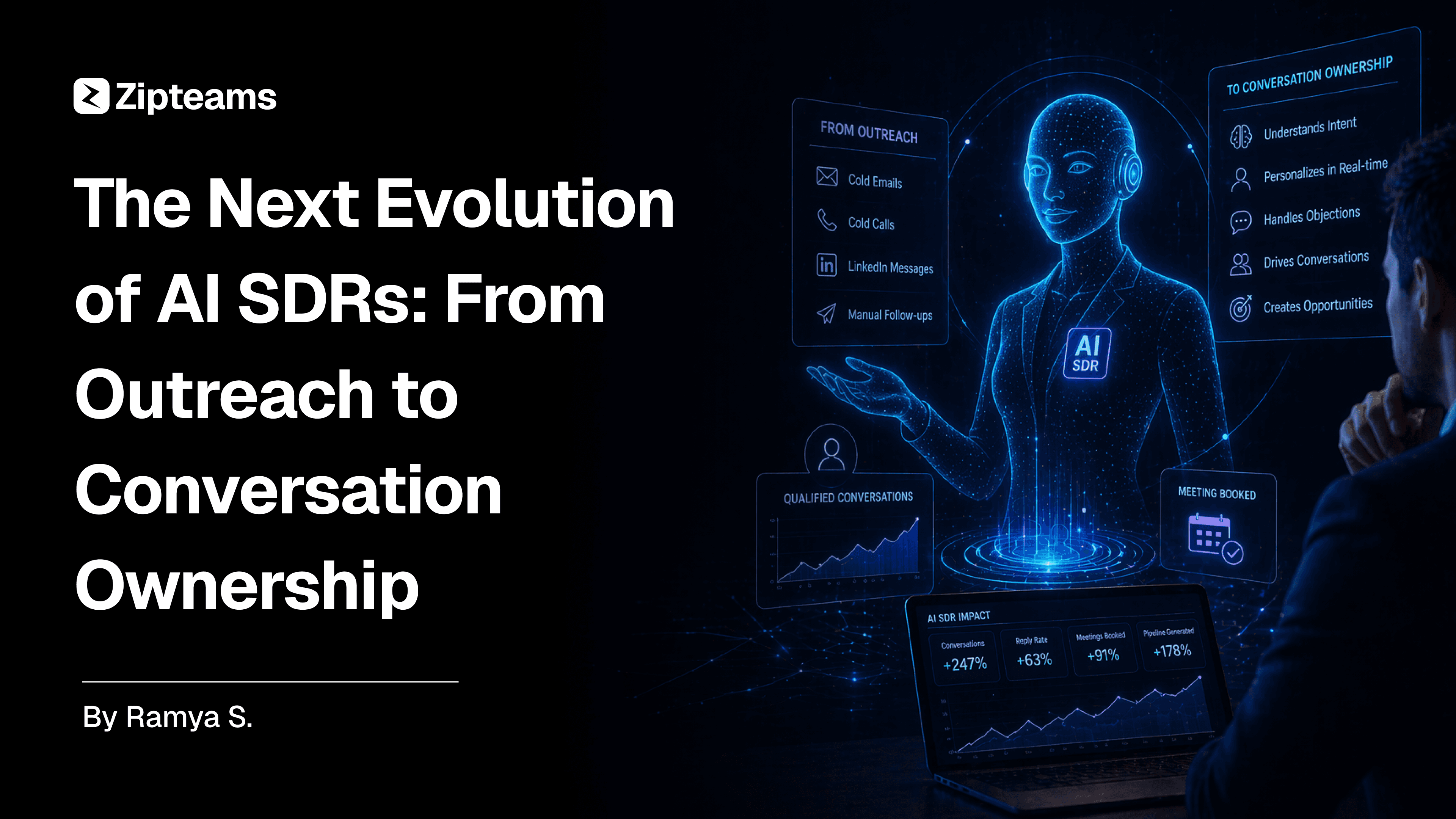
In 2023, AI SDRs were mostly used for automated outreach—sending cold emails, follow-ups, and basic responses at scale.
By 2026, that model is already outdated.
The leading sales teams are no longer using AI just to start conversations. They’re using it to own the entire conversation lifecycle—from first touch to qualified meeting—without human intervention.
This shift is subtle, but massive.
So what does “conversation ownership” actually mean—and how is it changing the role of SDRs?
What is Conversation Ownership in AI SDRs?
Conversation ownership means the AI SDR doesn’t just initiate outreach—it:
Starts the conversation
Drives it forward
Qualifies the lead
Handles objections
Books the meeting
All while maintaining context across multiple interactions and channels.
What it includes:
Multi-turn, dynamic conversations
Context retention across sessions
Real-time personalization
Autonomous decision-making within defined guardrails
What it does NOT include:
Complex deal negotiation
Deep technical discovery
Final closing conversations
Key idea: AI SDRs are evolving from message senders → conversation managers.
Why Outreach-Only AI SDRs Are No Longer Enough
Early AI SDR tools focused on:
Cold email automation
Sequence optimization
Basic reply handling
This created scale—but not necessarily conversion.
The limitations of outreach-only systems:
Conversations break after the first reply
No real qualification happens
SDRs still need to step in early
Context is lost between interactions
Result: More activity, but not more pipeline.
What Changed Between 2023 and 2026
Three major shifts enabled this evolution:
1. More capable LLMs
Modern models can:
Understand intent more accurately
Handle multi-turn conversations
Respond contextually, not just reactively
2. Better data integration
AI SDRs now connect with:
CRM systems
Website behavior tracking
Email and messaging platforms
This gives them full context, not just message history.
3. Shift from automation → autonomy
Earlier tools followed rules.
Now, AI SDRs:
Make decisions
Adapt flows dynamically
Optimize conversations in real time
Outreach vs Conversation Ownership: Key Differences
Factor | Outreach-Based AI | Conversation Ownership AI |
Role | Message sender | Conversation driver |
Interaction depth | Single-touch or limited | Multi-turn, continuous |
Context awareness | Low | High |
Qualification | Minimal | Structured and dynamic |
Objection handling | Weak | Strong |
Human dependency | High | Reduced |
Conversion impact | Moderate | High |
How Conversation Ownership Works: Step-by-Step
This is how modern AI SDRs operate in 2026.
Step 1: Trigger-Based Conversation Start
The AI initiates conversations based on:
Website behavior (pricing page, demo page)
Form submissions
Outbound campaign responses
Product usage signals
Key difference: Conversations start with context, not cold outreach.
Step 2: Context-Aware Opening Message
Instead of generic messages, AI uses:
Page visited
Industry
Role
Previous interactions
Example:
A repeat visitor to pricing gets:
“Looks like you're evaluating options—happy to walk you through pricing or use cases.”
Step 3: Multi-Turn Engagement
Unlike earlier tools, AI now:
Asks follow-up questions
Adapts based on responses
Maintains natural flow
Why it matters:
Real conversations—not scripted interactions—drive conversion.
Step 4: Dynamic Qualification
AI qualifies leads in real time by:
Asking relevant questions
Adjusting based on answers
Identifying intent and fit
It doesn’t follow a rigid checklist—it adapts.
Step 5: Objection Handling Within the Flow
Instead of escalating immediately, AI:
Responds to objections
Provides relevant information
Keeps the conversation moving
Example:
“Just researching” → AI offers a quick resource + follow-up.
Step 6: Cross-Channel Continuity
Conversation ownership means continuity across:
Website chat
Email
SMS / WhatsApp
The AI remembers:
What was said
What was asked
What stage the lead is in
Impact: No reset between channels.
Step 7: Autonomous Decision Making
AI decides:
Whether to push for a meeting
Whether to nurture
Whether to follow up later
All based on:
Intent signals
Responses
Behavior
Step 8: Meeting Conversion
When the lead is ready, AI:
Suggests time slots
Books instantly
Sends confirmations
No friction. No delay.
Step 9: Continuous Conversation Management
Even after initial interaction, AI:
Follows up
Re-engages
Nurtures
Until:
Meeting is booked
Lead is disqualified
Or intent fades
Why Conversation Ownership Increases Conversion Rates
This model works because it removes key friction points:
1. No drop-off between messages
The conversation doesn’t stop after the first reply.
2. No delay in engagement
AI responds instantly, every time.
3. No context loss
Every interaction builds on the previous one.
4. No missed follow-ups
Every lead is continuously engaged.
5. No inconsistency
Every conversation meets the same quality standard.
Where This Model Works Best
Conversation ownership is most effective when:
You have high inbound traffic
Buyers prefer quick interactions
Sales cycles are under 90 days
Leads need moderate qualification
Speed is a competitive advantage
Where It Still Has Limits
This model is less effective when:
Deals require deep technical discovery
Multiple stakeholders are involved early
Enterprise procurement processes dominate
Conversations require strong human relationship-building
Even then, AI still owns early-stage engagement effectively.
How to Transition from Outreach to Conversation Ownership
1. Shift from sequences to conversations
Stop thinking:
Email sequences
Start thinking:
Continuous dialogue
2. Define conversation goals
Each interaction should aim to:
Qualify
Educate
Convert
3. Integrate data sources
Connect:
CRM
Website tracking
Messaging platforms
Context is critical.
4. Train for objections
Build AI logic for:
Common pushbacks
Real buyer concerns
5. Monitor conversation quality
Review:
Real conversations
Drop-off points
Conversion triggers
Frequently Asked Questions
What is conversation ownership in AI SDRs?
It means the AI manages the entire lead interaction—from first message to meeting booking—without human intervention.
How is this different from traditional AI SDRs?
Traditional tools focus on outreach. Modern AI SDRs manage full conversations, including qualification and objection handling.
Does this replace human SDRs?
No. It reduces their workload and allows them to focus on high-value interactions.
Why is conversation ownership more effective?
Because it maintains engagement, context, and momentum throughout the buyer journey.
Can AI handle complex conversations?
To an extent. It performs well in structured, repeatable scenarios but still struggles with highly complex discussions.
What’s the biggest benefit of this shift?
Higher conversion rates due to continuous, context-aware engagement.
Final Thoughts
AI SDRs are no longer just tools for sending messages.
They are becoming systems that manage conversations end-to-end.
This evolution changes how sales teams operate:
Less manual follow-up
Fewer dropped leads
More consistent engagement
Higher conversion rates
In 2026, the advantage isn’t just reaching more leads—it’s owning the conversation from start to finish.
The teams that adopt this model are building faster pipelines with less effort.
The ones that don’t are still stuck optimizing outreach—while missing what happens after the first reply.