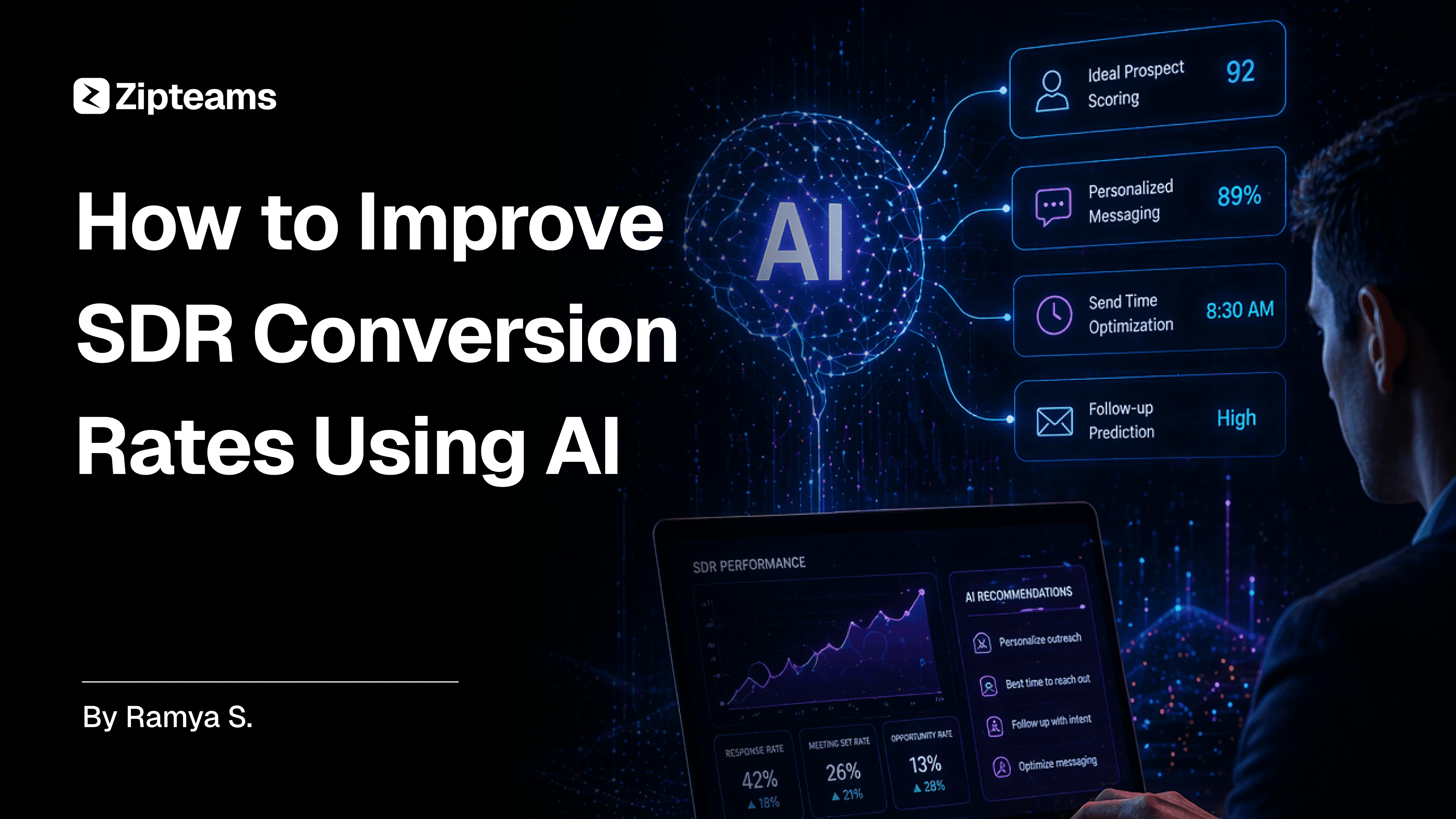
How to Improve SDR Conversion Rates Using AI
This blog describes what actually moves the needle in SDR conversion rates and how does AI improve SDR performance in measurable ways?
Ramya S.
B2B Sales
Sales
CRM
Sales Team
Productivity
Appointment Scheduling
Appointment Scheduling
Customer Conversation
Sales Acceleration
Virtual Sales
In 2022, improving SDR conversion rates meant hiring more reps, refining scripts, and running more training sessions.
By 2026, the playbook has changed.
Today, the highest-performing sales teams don’t just rely on better SDRs—they rely on AI systems that optimize every step of the conversion journey, from first response to meeting booked.
Yet many teams still struggle with low conversion rates despite strong lead volume.
So what actually moves the needle—and how does AI improve SDR performance in measurable ways?
What is SDR Conversion Rate?
SDR conversion rate refers to the percentage of leads that move from initial engagement to a booked meeting or qualified opportunity.
Common conversion stages:
Lead → Conversation started
Conversation → Qualified lead
Qualified lead → Meeting booked
What it includes:
Speed of engagement
Quality of conversations
Lead qualification accuracy
Follow-up effectiveness
What it does NOT include:
Closing deals (owned by AEs)
Marketing lead generation quality
Late-stage pipeline conversion
Key idea: SDR conversion rate is the efficiency of turning interest into pipeline.
Why SDR Conversion Rates Are Low (Even With Good Leads)
Most teams assume low conversion is a lead quality issue.
In reality, it’s usually an execution problem.
Common causes:
Slow response times (minutes → hours → days)
Inconsistent follow-ups
Generic messaging
Poor qualification
Missed high-intent signals
Result: Good leads don’t convert—not because they aren’t interested, but because engagement is mistimed or ineffective.
How AI Changes SDR Performance
AI doesn’t just automate tasks—it removes the biggest sources of conversion loss:
Delays
Inconsistency
Human bandwidth limits
Missed signals
What AI does differently:
Responds instantly (no delay)
Engages every lead (no drop-off)
Personalizes at scale
Qualifies in real time
Follows up continuously
Impact: More conversations → better qualification → more meetings booked.
Traditional SDR vs AI-Assisted SDR
Factor | Traditional SDR | AI-Assisted SDR |
Response time | Minutes to hours | Instant (seconds) |
Lead coverage | Limited | 100% coverage |
Personalization | Manual, inconsistent | Automated, scalable |
Follow-ups | Often missed | Always executed |
Qualification | Manual | Structured + data-driven |
Conversion consistency | Variable | Predictable |
The best teams in 2026 don’t replace SDRs—they augment them with AI.
How AI Improves SDR Conversion Rates: Step-by-Step
This is where the real impact happens.
Step 1: Instant Lead Engagement
AI eliminates the biggest conversion killer: delay.
The moment a lead:
Fills a form
Visits pricing
Starts a chat
AI engages immediately.
Why it matters:
Captures peak intent
Starts conversations before competitors
Increases reply rates significantly
Step 2: Intelligent Lead Qualification
Instead of generic discovery, AI asks structured questions like:
Team size
Use case
Budget
Timeline
It then:
Segments leads (high / medium / low intent)
Prioritizes high-value prospects
Impact: SDRs focus only on leads that are worth converting.
Step 3: Real-Time Personalization
AI tailors every interaction based on:
Industry
Role
Company size
Behavior (pages visited, actions taken)
Example:
A VP of Sales visiting pricing gets a very different message than a junior marketer reading a blog.
Why it matters:
Generic messaging reduces engagement. Context-driven messaging increases replies.
Step 4: Behavioral Intent Tracking
AI doesn’t just listen—it observes.
It tracks:
Page visits
Time spent
Return frequency
Email clicks
Then adjusts outreach accordingly.
Example:
Pricing page + repeat visit → high intent → immediate follow-up
Blog reader → nurture sequence
Impact: Right message, right time.
Step 5: Automated, Persistent Follow-Ups
Most SDRs miss follow-ups due to workload.
AI doesn’t.
It executes:
Day 1: Initial outreach
Day 3: Follow-up
Day 7: Re-engagement
Ongoing nurture
Why it matters:
A large percentage of conversions happen after multiple touches.
Step 6: Objection Handling at Scale
AI is trained to handle common objections:
“Just researching”
“Too expensive”
“Not now”
“Using a competitor”
Instead of dropping off, it:
Responds instantly
Keeps the conversation alive
Redirects toward value
Impact: More recovered leads → higher conversion rate.
Step 7: Seamless Meeting Scheduling
AI removes friction from booking:
Shows available time slots
Syncs calendars
Confirms instantly
No:
Back-and-forth emails
Lost momentum
Result: Higher meeting booking rate.
Step 8: Continuous Optimization
AI systems learn from:
Which messages convert
Which flows fail
Which segments perform best
Over time:
Messaging improves
Qualification sharpens
Conversion rates increase
Key advantage: Performance compounds.
Where AI Drives the Biggest Conversion Gains
AI has the highest impact in:
1. High inbound volume teams
More leads than SDRs can handle → AI ensures no drop-off.
2. Fast sales cycles
Speed directly impacts conversion.
3. SMB and mid-market segments
Standardized qualification → easier automation.
4. Multi-channel engagement
AI coordinates across:
Chat
Email
SMS
WhatsApp
When AI Has Less Impact
AI is less effective when:
Sales require deep technical discovery
Deals involve multiple stakeholders early
Enterprise procurement dominates
Conversations are highly relationship-driven
Even then, AI still improves top-of-funnel efficiency.
5-Step Framework to Improve SDR Conversion Rates Using AI
1. Define your Ideal Customer Profile (ICP)
AI needs clear targeting:
Industry
Company size
Use case
Without this, qualification breaks.
2. Map your qualification logic
Identify 4–6 key questions that determine:
Fit
Intent
Readiness
3. Automate first touch
Every lead should be engaged instantly:
Chat
Email
Messaging
No exceptions.
4. Implement structured follow-ups
Design sequences that:
Add value
Re-engage
Adapt to behavior
5. Review and optimize weekly
Analyze:
Conversations
Drop-offs
Conversion rates
Refine continuously.
Frequently Asked Questions
What is a good SDR conversion rate?
It varies by industry, but typically ranges between 10–30% from lead to meeting. High-performing teams exceed this with strong execution.
How does AI increase SDR conversion rates?
By improving speed, consistency, personalization, and follow-ups—eliminating the main causes of conversion loss.
Does AI replace SDRs?
No. AI handles repetitive, high-volume tasks, while SDRs focus on high-value conversations.
What is the biggest conversion killer?
Slow response time. Even high-quality leads drop off if engagement is delayed.
Can AI improve outbound SDR conversion?
Yes. AI can personalize outreach, optimize timing, and automate follow-ups at scale.
How long does it take to see results?
Most teams see measurable improvement within 30–60 days after implementing AI-driven workflows.
Final Thoughts
Improving SDR conversion rates isn’t about working harder—it’s about removing friction from the system.
In 2026, the gap between average and high-performing sales teams isn’t effort—it’s execution speed, consistency, and intelligence.
AI delivers all three.
The teams that adopt it are:
Converting more leads
Booking more meetings
Generating more pipeline from the same input
The rest are still relying on manual processes—and losing opportunities they never even see.
The question isn’t whether AI improves SDR conversion rates.
It’s how much conversion you’re losing without it.