How to Train an AI SDR for Your ICP
In this blog, you will learn how do you train your AI SDR to consistently qualify the right leads and convert them into meetings.
Ramya S.
May 18, 2026
B2B Sales
Generative AI
Sales
CRM
Sales Team
Productivity
Generative AI
Most AI SDR implementations fail for one simple reason:
They’re not trained properly.
Not because the AI isn’t capable—but because the inputs are vague, incomplete, or misaligned with the Ideal Customer Profile (ICP).
An AI SDR is only as effective as the context you give it.
So how do you train it to consistently qualify the right leads and convert them into meetings?
What Does “Training an AI SDR” Actually Mean?
Training an AI SDR doesn’t mean coding or machine learning.
It means configuring the system with:
Clear targeting (ICP)
Qualification logic
Conversation guidelines
Real-world scenarios
What it includes:
Defining who to target
Teaching how to qualify
Setting conversation flows
Handling objections
What it does NOT include:
Building models from scratch
Writing complex algorithms
Manual learning processes
Key idea: You’re not training the AI—you’re teaching it how your sales team thinks.
Why ICP Alignment Is Critical
Without a clear ICP, the AI:
Engages the wrong leads
Qualifies inconsistently
Books low-quality meetings
With strong ICP alignment:
Higher-quality pipeline
Better conversion rates
Less wasted sales time
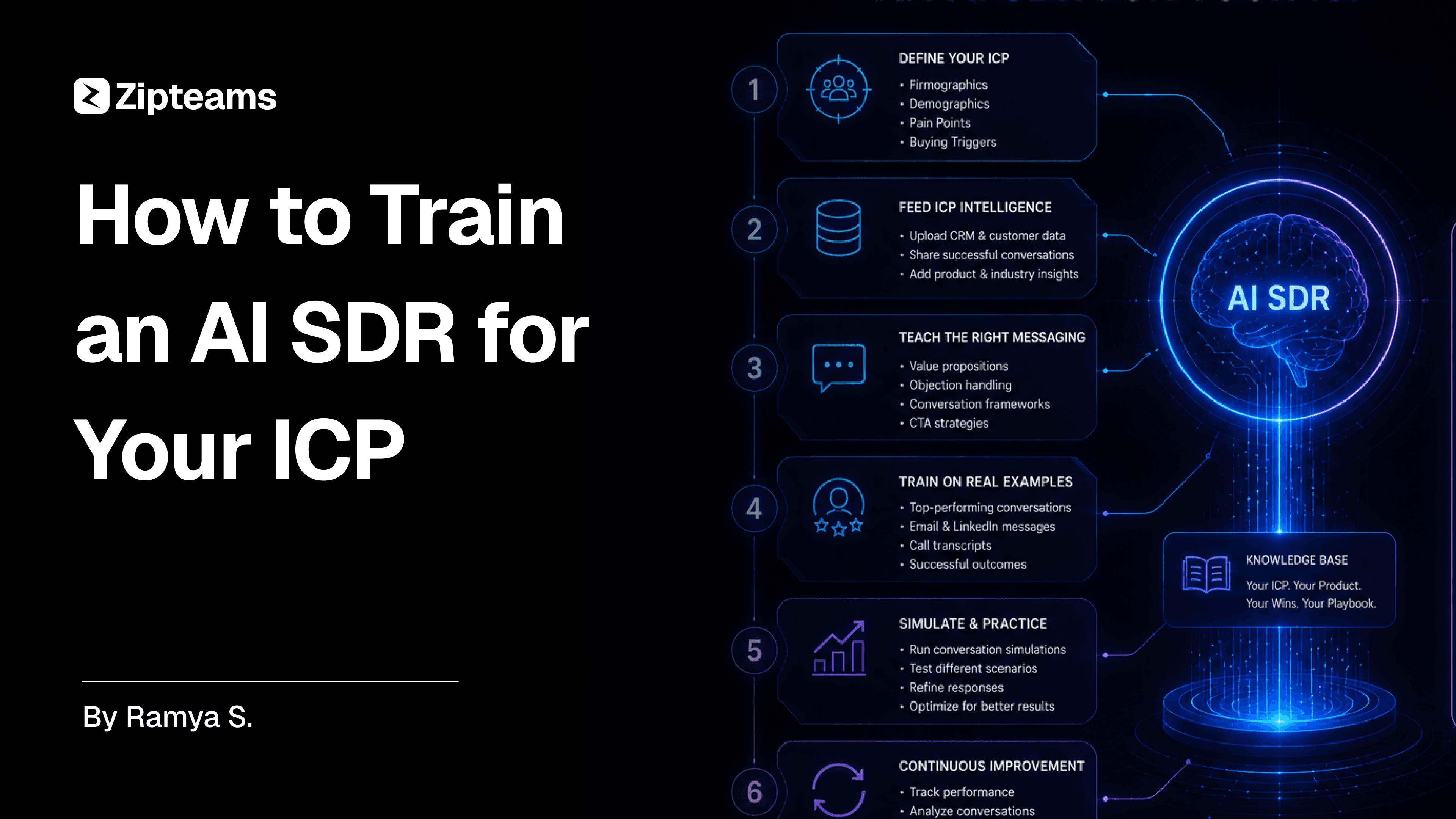
Step-by-Step: How to Train an AI SDR for Your ICP
Step 1: Define Your ICP Clearly
Start with:
Industry
Company size
Geography
Tech stack
Use cases
Example:
“B2B SaaS companies with 50–500 employees using HubSpot and generating inbound leads”
Why it matters:
This determines who the AI prioritizes.
Step 2: Identify Qualification Criteria
Define 4–6 key questions that separate:
Qualified vs unqualified
High intent vs low intent
Examples:
Team size
Budget range
Timeline
Current tools
Tip: Keep it focused—too many questions reduce engagement.
Step 3: Map Buyer Personas
Different roles care about different things.
Define:
Pain points
Goals
Objections
Example:
VP Sales → pipeline growth
CTO → integration + security
Impact: Better personalization.
Step 4: Create Conversation Guidelines
Set rules for:
Tone (professional, friendly, direct)
Length of responses
When to ask questions
When to push for meetings
This ensures consistency.
Step 5: Train Objection Handling
Prepare responses for:
“Not interested”
“Too expensive”
“Just researching”
“Using competitor”
AI should:
Acknowledge
Add value
Keep conversation alive
Step 6: Define Conversion Triggers
Tell the AI when to:
Push for a meeting
Continue nurturing
Disqualify
Example:
High intent + good fit → book meeting
Medium intent → follow-up sequence
Step 7: Integrate Behavioral Data
Use signals like:
Pages visited
Time spent
Repeat visits
This improves:
Timing
Relevance
Conversion
Step 8: Review and Refine
In the first 2–4 weeks:
Review real conversations
Identify drop-offs
Adjust responses
Key insight: Training is iterative.
Common Mistakes to Avoid
1. Vague ICP
Leads to poor targeting.
2. Overloading with questions
Reduces engagement.
3. Ignoring objections
Causes drop-offs.
4. No follow-up logic
Leads go cold.
5. No review process
Performance stagnates.
What Good AI SDR Training Looks Like
A well-trained AI SDR:
Engages the right leads
Asks relevant questions
Handles objections smoothly
Books qualified meetings
Improves over time
How Long Does Training Take?
Initial setup: 1–2 weeks
Optimization: 30–60 days
Full performance maturity: ~90 days
Frequently Asked Questions
Do you need technical skills to train an AI SDR?
No. Most platforms are no-code or low-code.
How important is ICP definition?
It’s the most critical factor. Without it, everything else breaks.
Can AI learn automatically?
Yes, but it needs structured inputs and ongoing refinement.
How often should you update training?
Weekly in the first month, then monthly.
What’s the biggest mistake teams make?
Treating AI like a plug-and-play tool without proper setup.
Final Thoughts
Training an AI SDR isn’t about technology—it’s about clarity.
The clearer your ICP, qualification logic, and conversation strategy, the better your AI performs.
In 2026, the difference between average and high-performing AI SDR deployments isn’t the tool.
It’s how well it’s trained.
Because at the end of the day, your AI SDR is a reflection of your sales strategy—just executed at scale.