Start your first month free! Get 5,000 credits to put ZIP to work.
Sign up free
AI SDR vs AI Chatbot: What’s the Real Difference?
This article explains the real difference between an AI SDR and an AI chatbot—and which one actually drives revenue?
Ramya S.
B2B Sales
Generative AI
Sales
Sales Team
Appointment Scheduling
Appointment Scheduling
Meeting Rooms
Generative AI
Sales Acceleration
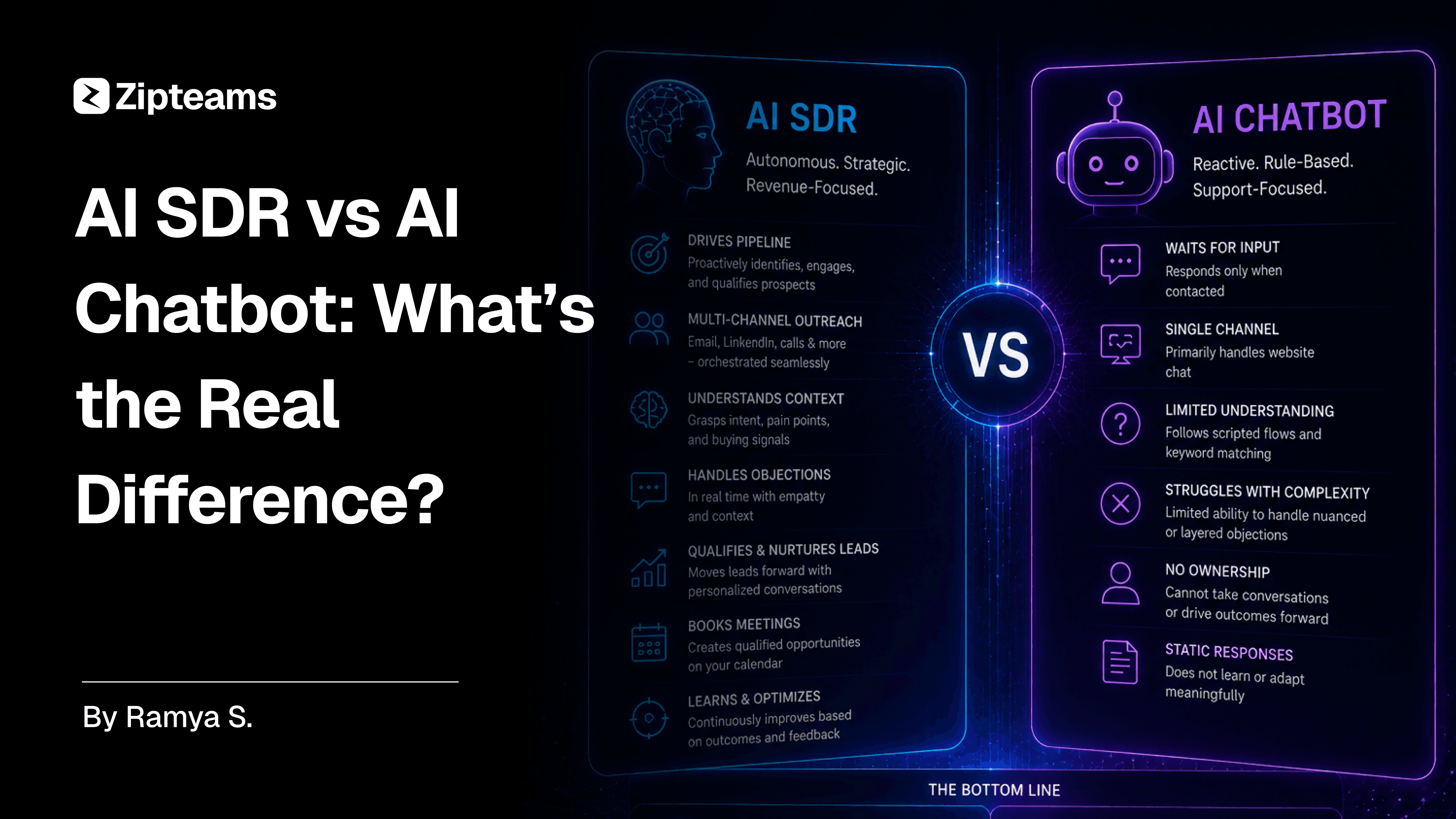
In 2022, most companies used chatbots for basic website interactions—answering FAQs, routing queries, and collecting contact details.
By 2026, many of those same companies are deploying AI SDRs—systems that don’t just respond, but actively drive sales conversations, qualify leads, and book meetings.
At a glance, both may look similar. They sit on your website, reply instantly, and use AI.
But under the hood, they are fundamentally different.
So what’s the real difference between an AI SDR and an AI chatbot—and which one actually drives revenue?
What is an AI Chatbot?
An AI chatbot is a system designed to respond to user queries, typically in a support or information context.
What it does:
Answers FAQs
Provides product or feature information
Routes users to the right team
Collects basic lead details
What it does NOT do:
Drive sales conversations proactively
Qualify leads deeply
Handle objections strategically
Book meetings autonomously
Key idea: A chatbot reacts. It does not sell.
What is an AI SDR?
An AI SDR (Sales Development Representative) is designed to engage, qualify, and convert leads into meetings.
What it does:
Initiates conversations (inbound + outbound)
Asks qualification questions
Handles objections
Follows up automatically
Books meetings
What it does NOT do:
Close deals
Run deep technical discovery
Replace AEs
Key idea: An AI SDR doesn’t just respond—it drives the conversation toward conversion.
AI SDR vs AI Chatbot: Core Differences
Factor | AI Chatbot | AI SDR |
Primary goal | Answer queries | Generate pipeline |
Interaction type | Reactive | Proactive + reactive |
Conversation depth | Shallow | Multi-turn, dynamic |
Qualification | Minimal | Structured + adaptive |
Objection handling | Limited | Strong |
Follow-ups | Rare | Continuous |
Meeting booking | Usually manual | Automated |
Revenue impact | Indirect | Direct |
How They Actually Work (Under the Hood)
AI Chatbot Flow
User asks a question
Bot retrieves or generates an answer
Conversation ends or escalates
Limitations:
No memory across interactions
No structured qualification
No progression toward a goal
AI SDR Flow
Detects lead intent (visit, form, reply)
Initiates conversation
Asks qualification questions
Adapts responses dynamically
Handles objections
Follows up if needed
Books meeting
Key difference: The AI SDR has a clear objective—conversion.
Where Chatbots Fail (and AI SDRs Win)
1. No Conversation Ownership
Chatbots answer and stop.
AI SDRs drive the next step.
2. No Qualification Logic
Chatbots collect data.
AI SDRs evaluate fit and intent.
3. No Follow-Up System
Chatbots wait for the user.
AI SDRs re-engage automatically.
4. No Revenue Accountability
Chatbots support the experience.
AI SDRs are tied directly to pipeline metrics.
When to Use an AI Chatbot
Chatbots are still useful when:
You need support automation
Queries are repetitive
Sales involvement is minimal
You want quick information delivery
Example use cases:
Help center
Product documentation
Basic onboarding
When to Use an AI SDR
AI SDRs are ideal when:
You have inbound traffic
You want to increase conversions
Leads require qualification
Sales teams are overloaded
Example use cases:
SaaS lead generation
Demo booking
Mid-market sales funnels
Can You Use Both Together?
Yes—and the best teams do.
Typical setup:
Chatbot handles support queries
AI SDR handles sales conversations
Some modern systems combine both—but the intent layer (support vs sales) must still be clearly defined.
The Business Impact Difference
AI Chatbot:
Improves user experience
Reduces support load
Saves time
AI SDR:
Increases meetings booked
Improves conversion rates
Generates pipeline
Bottom line:
Chatbots save cost.
AI SDRs drive revenue.
How to Choose Between AI SDR and Chatbot
Ask yourself:
Do you want to answer questions—or convert leads?
Do your leads need qualification?
Is speed-to-lead important?
Are you losing inbound opportunities?
If your goal is pipeline → AI SDR
If your goal is support → Chatbot
Frequently Asked Questions
Is an AI SDR just an advanced chatbot?
No. While both use AI, an AI SDR is designed for sales conversion, not just answering questions.
Can chatbots be upgraded into AI SDRs?
Not easily. AI SDRs require deeper logic, integrations, and conversation flows built around qualification and conversion.
Do AI SDRs replace chatbots?
No. They serve different purposes—sales vs support.
Which one improves conversion rates?
AI SDRs, because they actively engage, qualify, and follow up with leads.
Are AI SDRs more expensive?
Yes, but they generate direct ROI through pipeline creation, unlike chatbots which mainly reduce costs.
Final Thoughts
The difference between an AI chatbot and an AI SDR isn’t technical—it’s strategic.
One answers questions.
The other drives revenue.
In 2026, companies that treat both as the same tool are leaving pipeline on the table.
The ones that separate support automation from sales automation—and invest in conversation ownership—are the ones converting more leads without increasing headcount.