Start your first month free! Get 5,000 credits to put ZIP to work.
Sign up free
How AI Sales Agents Handle Objections in Real Time
This guide breaks down the exact system, frameworks, and measurable impact of AI-driven objection handling across the sales funnel.
Ramya S.
B2B Sales
Generative AI
Sales
CRM
Sales Team
Remote Selling
Generative AI
Sales Acceleration
Virtual Selling
Virtual Sales
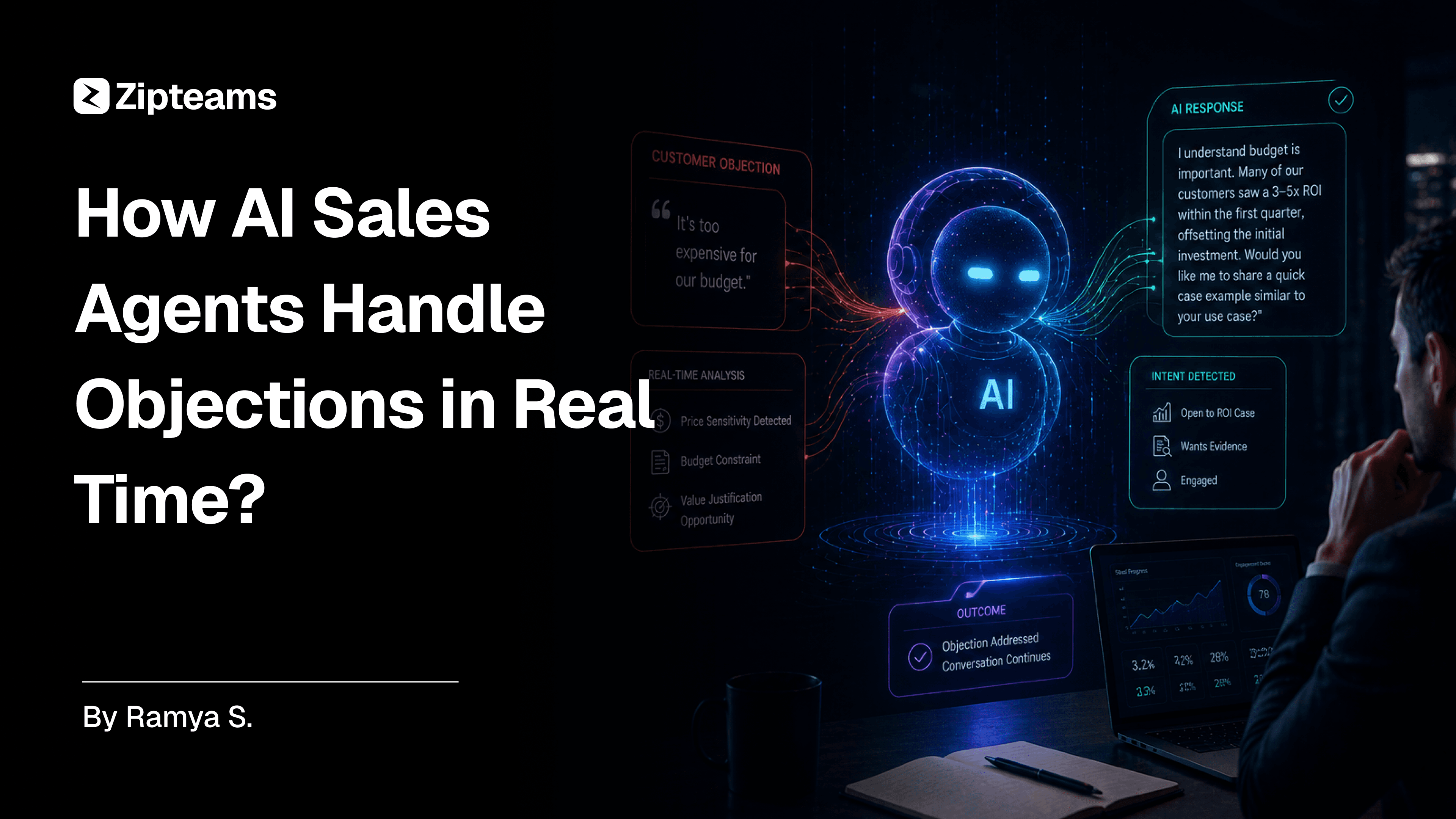
AI sales agents are no longer just automating outreach — they are actively participating in conversations, handling objections, and moving deals forward in real time.
The shift is significant. Traditionally, objection handling has been one of the most human-dependent parts of the sales process. Yet today, AI systems are resolving pricing concerns, timing hesitations, and competitor comparisons instantly — without delay, inconsistency, or emotional bias.
This raises a critical question for revenue teams:
How do AI sales agents actually handle objections in real time — and how effective are they compared to human reps?
This guide breaks down the exact system, frameworks, and measurable impact of AI-driven objection handling across the sales funnel.
Why Objection Handling Is the Highest-Leverage Moment in Sales
Objections are not blockers — they are signals of intent.
A prospect who raises concerns about:
pricing
implementation effort
ROI
timing
is already engaged.
The real risk is not the objection itself — it’s how long it takes to respond.
Research consistently shows:
Delayed responses reduce conversion probability dramatically
Inconsistent answers reduce trust
Poor framing kills momentum
Human reps struggle here due to:
response lag
knowledge gaps
emotional variability
context switching
AI sales agents solve these structurally.
The Real-Time Objection Handling Framework (How AI Does It)
AI sales agents don’t “wing it.” They follow a structured decision system.
Step 1: Instant Objection Detection
AI continuously analyzes:
message content
tone
intent signals
hesitation patterns
Common objection categories detected:
Price sensitivity (“This seems expensive”)
Timing issues (“Not the right time”)
Authority concerns (“Need to check with team”)
Trust gaps (“How is this different?”)
Unlike humans, detection happens in milliseconds.
Step 2: Intent Classification and Context Mapping
Once detected, the objection is mapped against:
ICP profile
company size
past interactions
funnel stage
deal context
This ensures responses are not generic.
Example:
A pricing objection from a startup ≠ pricing objection from an enterprise buyer.
Step 3: Response Strategy Selection
AI selects from predefined response strategies:
1. Reframe
Shift perception of cost → value
2. Clarify
Ask follow-up questions to understand real concern
3. Social Proof
Introduce case studies or benchmarks
4. Urgency
Highlight timing-related advantages
5. De-risk
Offer guarantees, trials, or low-commitment options
This is where most human reps are inconsistent.
AI is not.
Step 4: Real-Time Response Generation
The system generates responses that are:
context-aware
personalized
concise
aligned with sales playbooks
Example:
Objection: “This seems too expensive.”
AI Response:
Totally fair — most teams initially compare this to tools, not outcomes.
Companies similar to yours typically recover the cost within 2–3 months through increased pipeline conversion.
Would it help if I broke down ROI based on your current lead volume?
This response:
acknowledges concern
reframes value
introduces data
moves conversation forward
Step 5: Continuous Learning Loop
AI systems improve over time by tracking:
which responses lead to continued engagement
which objections lead to drop-offs
which phrings increase conversion
This creates compounding performance gains.
What Makes AI Better at Handling Objections
1. Zero Response Lag
Human response time:
minutes to hours
AI response time:
instant (sub-second)
Speed alone can increase qualification rates significantly.
2. Perfect Consistency
Every prospect receives:
best-performing response
correct positioning
accurate information
No variability.
3. Data-Backed Responses
AI pulls from:
case studies
benchmarks
historical deal data
Human reps often rely on memory.
4. No Emotional Bias
Humans:
get defensive
over-discount
avoid tough conversations
AI:
stays neutral
follows strategy
maintains positioning
The Impact on Conversion Metrics
When objection handling improves, downstream metrics shift.
Key Improvements Observed
1. Higher Engagement Retention
Fewer conversations drop after objections.
2. Improved Qualification Rate
More objections turn into qualified opportunities.
3. Better Meeting Conversion
Prospects move from interest → commitment faster.
4. Increased Pipeline Quality
Better objections = better-informed buyers.
What to Measure (Critical Metrics)
To evaluate AI objection handling, track:
Conversation-Level Metrics
Objection detection rate
Response time
Conversation continuation rate
Funnel Metrics
Lead → SQL conversion
Meeting show rate
Objection-to-meeting conversion
Revenue Metrics
Opportunity win rate
Deal cycle length
Average deal size
Where AI Objection Handling Goes Wrong
Even strong systems fail if implemented poorly.
1. Generic Responses
If AI is not trained on ICP-specific context, responses feel templated.
2. Over-Automation
Not all objections should be handled by AI.
High-stakes deals still need human intervention.
3. Lack of Feedback Loop
Without tracking outcomes, performance stagnates.
AI vs Human Objection Handling
Factor | Human SDR | AI Sales Agent |
Response Time | Minutes–Hours | Instant |
Consistency | Variable | High |
Personalization | Medium | High (data-driven) |
Emotional Bias | High | None |
Scalability | Limited | Unlimited |
Frequently Asked Questions
Can AI handle complex objections?
Yes — especially structured objections like pricing, ROI, and comparisons.
However, highly nuanced or political objections may still require human involvement.
Does AI reduce the need for human sales reps?
No. It shifts their role.
AI handles:
initial objections
repetitive concerns
early-stage conversations
Humans focus on:
closing
relationship building
complex negotiations
How quickly does AI improve objection handling performance?
Most systems show measurable improvement within 30–60 days, with significant gains after one full quarter of optimization.
What types of objections are best handled by AI?
pricing concerns
feature comparisons
ROI questions
implementation timelines
The Strategic Shift: Objections as a Growth Lever
The biggest mistake sales teams make is treating objections as friction.
In reality, objections are:
the highest-signal moments in the buying journey.
AI sales agents unlock this by:
responding instantly
handling objections consistently
improving with every interaction
The result is not just better conversations — but more predictable pipeline and revenue outcomes.
Final Insight
The question is no longer:
“Can AI handle objections?”
That’s already happening.