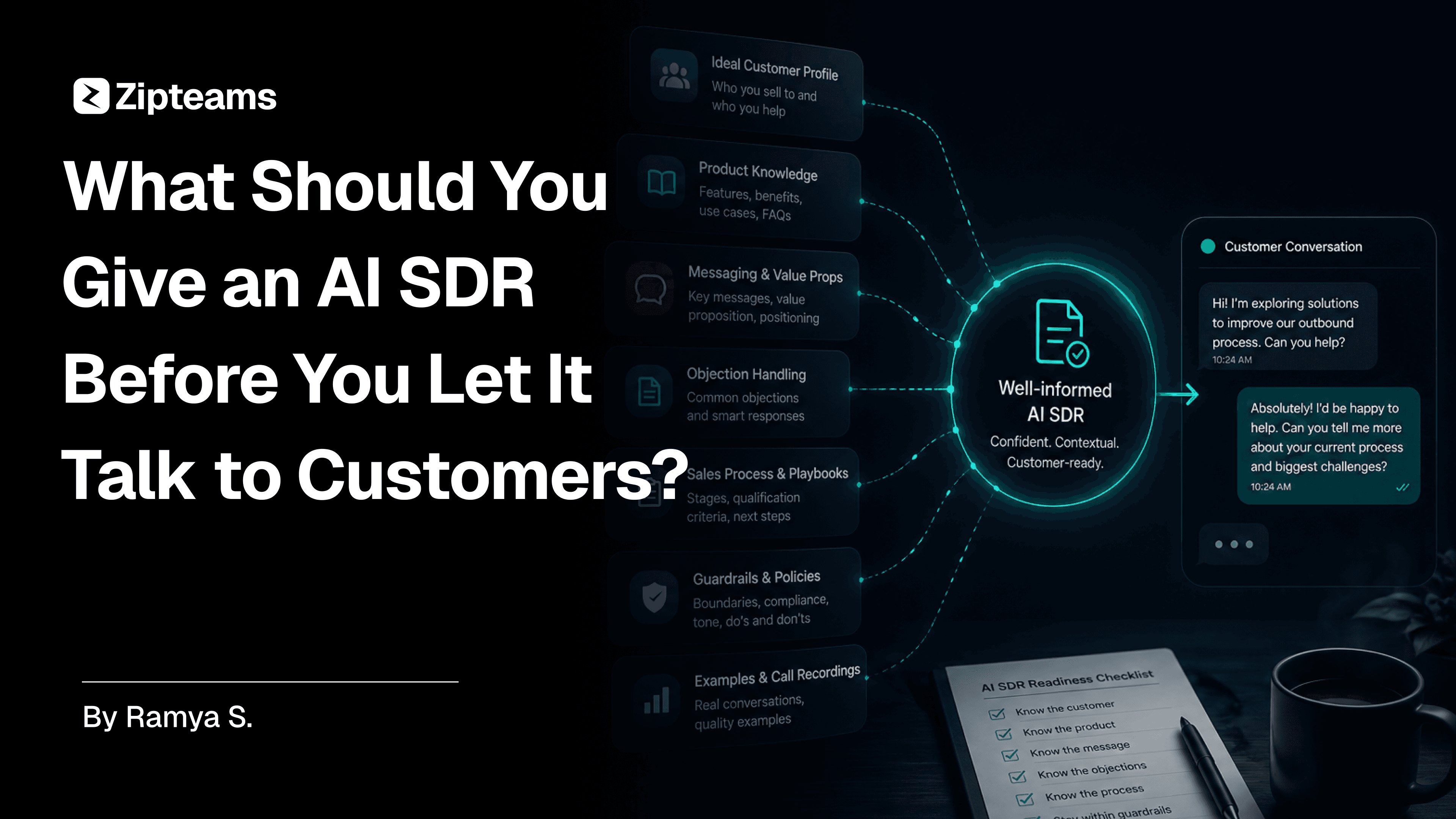
What Should You Give an AI SDR Before You Let It Talk to Customers?
Learn what an AI SDR needs before talking to customers, including product knowledge, customer context, qualification rules, guardrails, conversation memory, and escalation logic.
Aug 24, 2026
Giving an AI SDR access to your customer list is easy.
Giving it everything it needs to have a good sales conversation is much harder.
An AI SDR can send messages, answer questions, qualify leads, follow up, and schedule meetings at a scale that human SDRs can't match.
But scale amplifies both good and bad decisions.
If the AI has accurate product knowledge, clear qualification rules, customer context, and appropriate guardrails, it can create thousands of useful interactions.
If it doesn't, it can create thousands of confusing, inaccurate, or irrelevant ones just as quickly.
That's why deploying an AI SDR shouldn't start with:
"Which leads should we give it?"
It should start with:
"What does the AI need to know before it talks to anyone?"
The strongest AI SDR implementations treat the agent like a new sales team member.
Before giving it customer conversations, they give it the information, rules, context, and boundaries required to represent the company correctly.
The 8 Things an AI SDR Needs Before Customer Conversations
At a minimum, an AI SDR should have access to:
Product and company knowledge
Ideal customer profile
Lead and account context
Qualification criteria
Sales messaging
Objection-handling guidance
Conversation guardrails
Human escalation rules
And there's one more capability that becomes increasingly important:
Memory.
The AI should not only know what to say at the beginning of a conversation. It should be able to remember what the buyer says and use that information throughout the relationship.
Let's look at each layer.
1. Give the AI SDR Product Knowledge
The first requirement is obvious:
The AI needs to understand what you're selling.
But "product knowledge" is much more than a product description.
The AI should understand:
What the product does.
Who it is designed for.
Key features.
Main use cases.
Pricing and packaging.
Integrations.
Implementation requirements.
Product limitations.
Supported workflows.
Frequently asked questions.
For example, an AI SDR selling a CRM integration shouldn't simply know:
"We integrate with Salesforce."
It should understand:
What the integration supports.
How it works.
What data is synchronized.
Whether setup requires technical involvement.
Common implementation questions.
Known limitations.
The more specific the knowledge, the more useful the conversation.
2. Give It Your Ideal Customer Profile
An AI SDR shouldn't treat every lead as equally valuable.
It needs to understand who the product is actually for.
An ICP can include:
Industry.
Company size.
Geography.
Revenue range.
Technology stack.
Job roles.
Business problems.
Existing solutions.
Buying triggers.
For example:
A company might primarily sell to:
B2B SaaS companies with 50–500 employees that have an established sales team and are looking to improve outbound productivity.
That's far more useful than simply saying:
"Our customers are businesses."
The AI needs enough context to recognize fit.
3. Give It Lead Context
Product knowledge tells the AI what you sell.
ICP knowledge tells it who you want to sell to.
Lead context tells it who it's actually talking to.
Useful lead information can include:
Name.
Role.
Company.
Industry.
Previous interactions.
Lead source.
CRM stage.
Previous conversations.
Existing customer status.
Known interests.
Previous objections.
This prevents generic outreach.
Instead of:
"Hi, are you interested in learning more about our platform?"
The AI can say:
"I noticed your team has been exploring ways to improve lead response times. Is that still a priority for your sales team?"
The second conversation starts with a reason.
4. Give It Clear Qualification Criteria
One of the biggest mistakes organizations make is telling an AI SDR:
"Qualify the lead."
That's not enough.
The AI needs a clear definition of what "qualified" means.
Depending on your sales process, this could include:
Business Need
Does the prospect have a problem your product solves?
Fit
Does the company match your ICP?
Intent
Are they actively considering a solution?
Timeline
When do they expect to take action?
Authority
Who is involved in the buying decision?
Budget
Is there a realistic path to purchase?
The AI should also understand what disqualifies a lead.
Good qualification isn't just about finding reasons to say yes.
It's about knowing when the product isn't a fit.
5. Give It Your Sales Messaging
Your AI SDR should understand how your company talks to prospects.
This includes:
Positioning.
Value propositions.
Key differentiators.
Industry-specific messaging.
Common use cases.
Proof points.
Customer stories.
Competitive positioning.
But don't give it a giant document full of marketing copy and expect it to figure everything out.
Messaging should be organized around actual sales situations.
For example:
If the prospect cares about cost:
Explain the business impact and relevant ROI.
If the prospect cares about speed:
Explain how the product reduces time to execution.
If the prospect asks about competitors:
Explain relevant differences without making unsupported claims.
This turns product information into usable sales intelligence.
6. Give It Objection-Handling Guidance
Customers rarely move through a sales conversation without objections.
An AI SDR should know how to handle common concerns such as:
"This is too expensive."
"We're already using another tool."
"We don't have the resources to implement this."
"We need to talk internally."
"We're not ready yet."
"Send me some information."
"Why should we switch?"
The AI shouldn't respond with generic persuasion.
It needs structured guidance.
For each objection, define:
What the prospect is concerned about
What the AI should explain
What evidence it can provide
What it should never claim
When it should involve a human
This creates much more consistent conversations.
7. Give It Guardrails
This is one of the most important parts of AI SDR deployment.
An AI SDR needs to know not only what it can say, but also what it cannot say.
Guardrails can cover:
Claims
Don't invent product capabilities, integrations, customers, or results.
Pricing
Don't negotiate outside approved rules.
Competitors
Don't make unsupported or misleading claims.
Sensitive Information
Don't request or disclose information the AI isn't authorized to handle.
Commitments
Don't promise implementation timelines, discounts, or contractual terms without authorization.
Escalation
Know when a human needs to take over.
Good AI SDR systems are not simply given freedom.
They're given bounded autonomy.
8. Give It Human Escalation Rules
The AI should know when the conversation has moved beyond its role.
For example, escalate when:
A prospect explicitly asks for a salesperson.
A large enterprise opportunity is identified.
Pricing negotiation begins.
Contract terms are discussed.
A complex technical issue arises.
A security review is required.
The prospect raises a sensitive concern.
The buyer demonstrates strong purchase intent.
A human handoff should also include context.
The salesperson shouldn't receive:
"Lead wants to talk."
They should receive something closer to:
Company: ABC
Use case: Automating inbound lead qualification
Current solution: Manual SDR team
Primary concern: Response time
Timeline: This quarter
Key objection: Implementation effort
Conversation summary: Prospect is evaluating two solutions and requested pricing.
That's the difference between an AI handoff and an AI-assisted sales process.
9. Give It Long-Term Conversation Memory
Knowledge tells an AI what your company knows.
Memory tells it what this buyer has already said.
These are different.
An AI SDR should be able to retain relevant context such as:
Previous conversations.
Customer preferences.
Objections.
Purchase timelines.
Product interests.
Stakeholders.
Previous commitments.
Questions that remain unanswered.
Without memory, every conversation risks becoming a reset.
With memory, the AI can continue the relationship.
For example:
First conversation:
"We're interested, but our current contract runs until December."
Six months later:
"You mentioned your current contract was expected to end around December. Has your evaluation timeline changed?"
That's not just personalization.
That's continuity.
Knowledge and Memory Are Not the Same
This distinction is important when evaluating AI SDR platforms.
Knowledge | Memory |
|---|---|
What the company knows | What the buyer said |
Product information | Conversation history |
Pricing | Previous objections |
FAQs | Buyer preferences |
Sales playbooks | Purchase timeline |
Policies | Previous commitments |
Company positioning | Relationship context |
An AI SDR needs both.
Knowledge makes the AI accurate.
Memory makes the AI contextual.
10. Give It the Right Tools
An AI SDR becomes much more useful when it can actually perform actions.
Depending on your workflow, these may include:
CRM access.
Lead creation and updates.
Calendar scheduling.
Email.
WhatsApp.
Voice.
Website chat.
Knowledge base search.
Meeting booking.
Lead routing.
But tool access should follow permissions.
An AI should only be able to perform actions it is explicitly authorized to perform.
For example:
It may be allowed to update a lead stage.
It may not be allowed to delete customer records.
It may be allowed to schedule meetings.
It may not be allowed to modify contract terms.
This is another reason why bounded autonomy matters.
The AI SDR Setup Checklist
Before activating an AI SDR, ask:
Product
Does the AI understand our product?
Does it know our limitations?
Does it have current pricing information?
Does it know our integrations?
Customers
Does it understand our ICP?
Does it know which industries and roles matter?
Does it understand common customer problems?
Qualification
Does it know what makes a lead qualified?
Does it know what disqualifies a lead?
Does it understand our sales stages?
Conversations
Does it know our messaging?
Can it handle common objections?
Does it know when to ask questions?
Memory
Can it remember previous conversations?
Can it use previous context?
Does that context persist across channels?
Safety
Does it have clear guardrails?
Does it know what it cannot promise?
Does it know when to escalate?
Actions
Can it update the CRM?
Can it schedule meetings?
Can it send messages through approved channels?
If the answer to several of these is "no," the AI probably isn't ready to interact with customers independently.
What Happens When You Give an AI SDR Too Little Context?
Consider an AI SDR with only:
Product description.
Pricing page.
Generic sales prompt.
It may technically be able to talk.
But its conversations will likely feel generic.
It won't know:
Why the buyer is interested.
What they've already discussed.
Whether they fit your ICP.
What objections matter.
When to escalate.
What information it should avoid sharing.
This is how AI sales interactions become repetitive and frustrating.
What Happens When You Give It Too Much Unstructured Information?
The opposite problem exists too.
More information doesn't automatically produce better AI.
A knowledge base containing hundreds of documents can still be difficult for an AI SDR to use if the information is:
Outdated.
Contradictory.
Poorly organized.
Irrelevant.
Missing important context.
The goal isn't to give the AI everything.
It's to give it the right information in a form it can reliably use.
This is why a strong AI SDR knowledge layer matters.
The AI SDR Knowledge Layer
Think of an AI SDR as operating with several layers of context:
Company Knowledge
What your business offers.
↓
Customer Knowledge
Who you sell to and what they care about.
↓
Lead Context
Who this particular buyer is.
↓
Conversation Memory
What has already been discussed.
↓
Sales Rules
How the AI should qualify and engage.
↓
Guardrails
What the AI should and shouldn't do.
↓
Actions
What the AI is allowed to execute.
Together, these layers create the foundation for a reliable AI sales agent.
Don't Train the AI to Talk. Train It to Make Decisions.
This is perhaps the most important principle.
An AI SDR doesn't need thousands of clever sales phrases.
It needs clear decision-making rules.
For example:
If the buyer asks about pricing → provide approved pricing information and identify buying context.
If the buyer has high intent → prioritize qualification or meeting booking.
If the buyer raises a complex technical concern → escalate appropriately.
If the buyer says "not now" → capture the reason and enter a relevant nurture path.
If the buyer asks something outside the knowledge base → don't invent an answer.
This makes AI behavior more predictable.
Start Small Before You Scale
You don't need to give an AI SDR responsibility for every lead and every channel on day one.
A better approach is to start with:
One ICP.
One use case.
One or two channels.
A defined qualification framework.
A focused knowledge base.
Clear escalation rules.
Then monitor real conversations.
Look for:
Repeated questions.
Incorrect answers.
Poor qualification.
Unexpected objections.
Missing information.
Weak handoffs.
Use those observations to improve the AI system.
AI SDR deployment should be an iterative process, not a one-time configuration.
How to Know When Your AI SDR Is Ready
An AI SDR is ready for broader customer interaction when it can consistently:
Understand the buyer.
Answer accurately.
Ask relevant questions.
Qualify according to your rules.
Remember previous context.
Handle common objections.
Avoid unsupported claims.
Know when to stop.
Know when to escalate.
Pass complete context to human sales teams.
The goal isn't to make the AI autonomous at all costs.
The goal is to make it reliably useful.
Frequently Asked Questions
What information does an AI SDR need before talking to customers?
An AI SDR needs product knowledge, customer and ICP information, lead context, qualification rules, sales messaging, objection-handling guidance, conversation memory, guardrails, and clear human escalation rules.
How do you train an AI SDR?
Rather than relying only on traditional model training, organizations typically provide an AI SDR with structured instructions, a reliable knowledge base, customer context, qualification criteria, conversation examples, guardrails, and access to approved tools and systems.
What should an AI SDR know about a product?
It should understand product capabilities, use cases, pricing, integrations, implementation requirements, limitations, FAQs, differentiators, and approved claims.
Why does an AI SDR need a knowledge base?
A knowledge base gives the AI access to accurate and approved information that it can use when answering customer questions and conducting sales conversations.
Does an AI SDR need CRM data?
Yes. CRM data provides important context about leads, accounts, opportunities, previous activities, ownership, and sales stages. However, CRM data alone may not provide enough conversational context.
What are AI SDR guardrails?
AI SDR guardrails are rules that define what an AI sales agent can and cannot say or do. They can cover pricing, product claims, sensitive information, competitor statements, customer requests, actions, and human escalation.
How important is memory for an AI SDR?
Memory is critical for longer sales cycles and multi-touch engagement. It allows the AI SDR to remember previous conversations, objections, preferences, timelines, and commitments so future interactions can build on existing context.
Should an AI SDR have access to every company document?
Not necessarily. AI SDRs should have access to relevant, accurate, and up-to-date information rather than an unstructured collection of every company document.
When should an AI SDR hand a conversation to a human?
An AI SDR should escalate when a conversation requires human judgment, such as complex negotiations, sensitive issues, advanced technical questions, enterprise opportunities, or explicit requests to speak with a salesperson.
Conclusion
An AI SDR shouldn't start talking to customers the moment it has access to a messaging channel.
It needs a foundation first.
That foundation includes knowledge, context, qualification rules, memory, guardrails, tools, and human escalation paths.
Product knowledge helps the AI answer accurately.
Customer context helps it understand who it's talking to.
Qualification rules help it determine whether an opportunity is worth pursuing.
Memory allows it to maintain continuity.
Guardrails keep its actions within acceptable boundaries.
And escalation rules ensure humans step in when human judgment matters.
The best AI SDRs aren't simply given a prompt and a list of leads.
They're given the context and operating system required to behave like a capable member of the revenue team.
That is the difference between an AI that can talk to customers and an AI that can actually sell responsibly.