How AI SDRs Change When You Sell Across Multiple Channels
Learn how AI SDRs transform multi-channel sales by connecting email, WhatsApp, voice, and web conversations into one context-aware buyer journey.
Aug 21, 2026
A prospect receives an email from your sales team.
Later that day, they visit your website and ask a question.
The next morning, they respond to a WhatsApp message.
A few days later, they join a sales call.
For the buyer, these are all parts of the same conversation.
For many sales organizations, they are not.
The email lives in one system.
The website conversation lives somewhere else.
WhatsApp activity may be tracked separately.
The sales call sits in a conversation intelligence platform.
And the CRM contains only fragments of what actually happened.
This creates one of the biggest challenges in modern multi-channel sales:
Buyers experience one journey. Revenue teams often manage several disconnected conversations.
AI SDRs are changing this model.
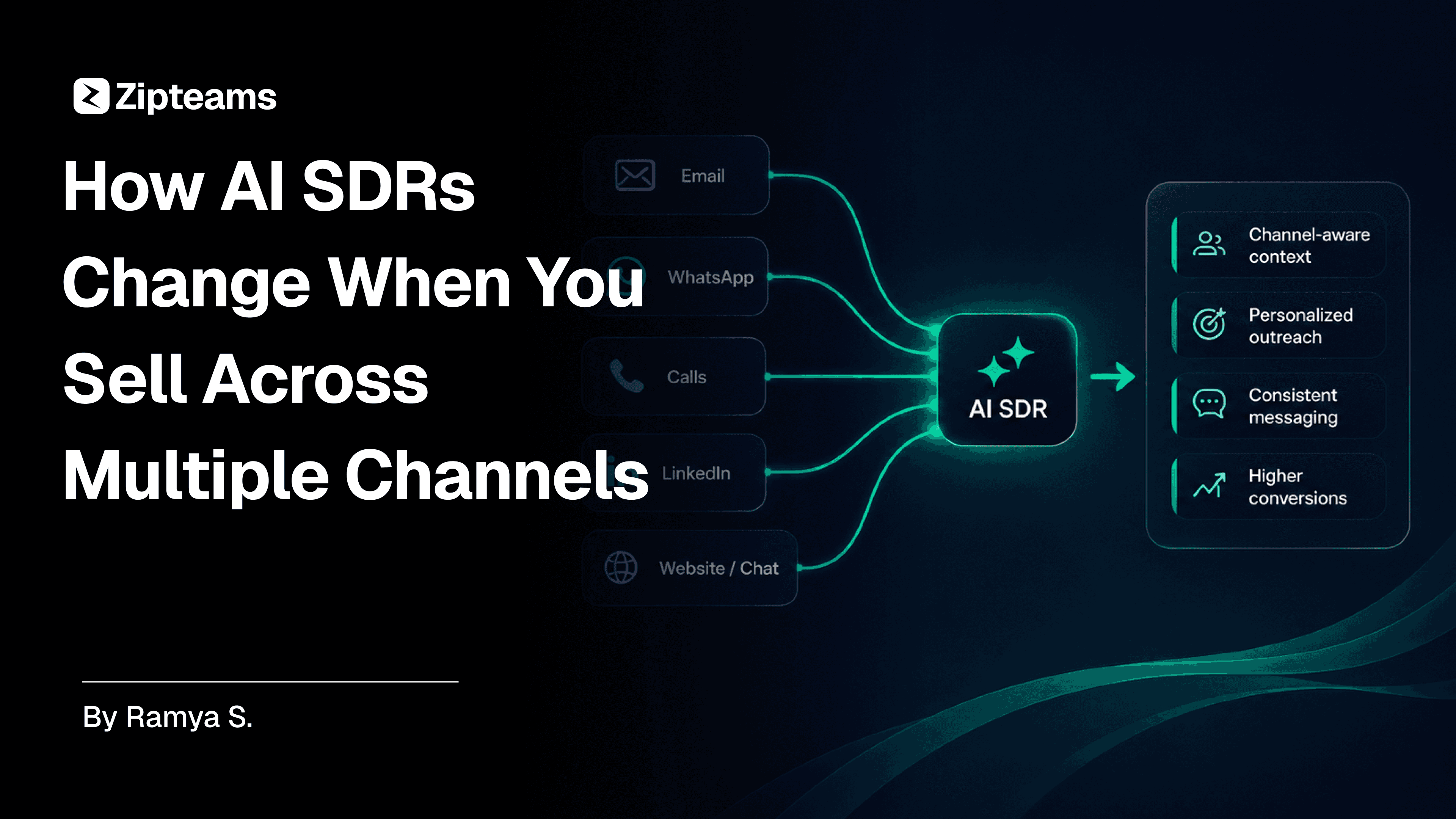
Instead of treating email, WhatsApp, voice, and website conversations as separate outreach channels, AI SDRs can connect them into a single, context-aware buyer journey.
This changes not only where sales teams communicate, but how they decide when, where, and what to communicate.
The future of multi-channel sales isn't about being present on every channel.
It's about making every channel part of the same conversation.
What Is Multi-Channel Sales?
Multi-channel sales is the practice of engaging prospects through multiple communication channels throughout the buying journey.
Depending on the business, these can include:
Email.
Phone and voice.
WhatsApp.
Website chat.
SMS.
LinkedIn.
Video meetings.
In-app messaging.
Each channel serves a different purpose.
Email may be useful for detailed information.
WhatsApp may work better for quick responses.
Voice can be useful for discovery.
Website conversations can capture intent at the moment a buyer is researching.
The challenge is coordinating all of them without creating a fragmented buyer experience.
Multi-Channel Doesn't Automatically Mean Omnichannel
These terms are often used interchangeably, but they describe different approaches.
Multi-channel sales
A company uses multiple channels to communicate with prospects.
However, each channel may operate independently.
Omnichannel sales
Multiple channels are connected so that context carries across the buyer journey.
For example:
A prospect asks a question through website chat.
The AI remembers the conversation.
The prospect later receives an email that references the same topic.
Then, during a voice conversation, the sales representative already knows what was discussed.
The channels are different.
The conversation is continuous.
That distinction becomes increasingly important as AI SDRs take responsibility for cross-channel engagement.
Why Traditional Multi-Channel Sales Breaks Down
Adding more channels can actually make sales operations more complicated.
A typical workflow might look like this:
Marketing → Email → SDR → WhatsApp → Website → Phone → CRM
Every handoff creates another opportunity for information to be lost.
A sales representative may not know:
What the buyer asked on the website.
Which email they responded to.
What they discussed on WhatsApp.
Which objections came up previously.
What another SDR already promised.
The result is repetitive conversations and inconsistent experiences.
The Biggest Problem Is Not Channel Management
The real problem is context management.
Suppose a prospect tells an AI SDR on WhatsApp:
"We're currently evaluating solutions and need Salesforce integration. Our target implementation date is October."
Later, the same prospect visits the website and starts another conversation.
If the website AI doesn't know about the WhatsApp interaction, it may ask:
"What are you looking for?"
The buyer now has to repeat themselves.
A connected AI SDR can instead respond based on existing context:
"You mentioned you're evaluating solutions for an October implementation and need Salesforce integration. Are you still working toward that timeline?"
The difference isn't the channel.
It's the memory.
AI SDRs Turn Multiple Channels Into One Conversation
AI SDRs can act as a shared intelligence layer across channels.
Instead of maintaining separate conversations, the system maintains a unified understanding of the buyer.
That understanding can include:
Previous conversations.
Buying intent.
Business needs.
Objections.
Product interests.
Qualification information.
Communication preferences.
Purchase timeline.
Stakeholder information.
The buyer can move between channels without losing context.
The Five Ways AI SDRs Change Multi-Channel Sales
1. AI Chooses the Right Channel for the Moment
Not every message belongs in every channel.
A buyer might prefer:
Email for detailed information.
WhatsApp for quick questions.
Voice for discovery.
Website chat for immediate support.
Traditional sales sequences often treat channel selection as a predefined workflow.
AI can make it more dynamic.
For example:
High-intent website visitor → Website conversation
Detailed product information requested → Email
Quick scheduling question → WhatsApp
Complex qualification → Voice or human handoff
The objective becomes matching the channel to the buyer's current need.
2. Context Follows the Buyer
One of the biggest advantages of AI SDRs is persistent context.
A buyer can move from:
Website → WhatsApp → Email → Voice
without restarting the conversation.
The AI can retain important information such as:
What the buyer is evaluating.
What they have already been told.
What questions remain unanswered.
What objections they raised.
What action was promised next.
This creates continuity across the entire journey.
3. Follow-Ups Become Event-Driven
Traditional multi-channel sequences often work on a schedule.
For example:
Day 1: Email
Day 3: WhatsApp
Day 7: Phone call
But the buyer's behavior doesn't necessarily follow that schedule.
AI SDRs can instead react to events.
For example:
A prospect:
Opens an email.
Returns to the pricing page.
Visits an integration page.
Starts a website conversation.
Those combined signals may indicate rising intent.
The next action should therefore change.
AI can recognize this progression and initiate the appropriate follow-up.
4. Channel Switching Becomes Intelligent
Buyers don't always stay in the same channel.
They might start with a website chat and then request WhatsApp.
Or they may prefer email after an initial voice conversation.
AI SDRs can use conversation context to determine when a channel change makes sense.
For example:
"Would you prefer that I send the implementation details over email?"
This creates a natural transition rather than forcing the buyer through a predefined sequence.
5. Human Handoffs Become More Valuable
Multi-channel AI doesn't mean humans disappear from the process.
Instead, AI can determine when human involvement creates more value.
For example, a prospect might:
Ask about pricing.
Discuss implementation.
Mention a large deployment.
Introduce multiple stakeholders.
Raise a complex security concern.
These signals can trigger a human handoff.
The important part is that the human shouldn't have to start from zero.
The AI should provide the relevant conversation context before the handoff.
Multi-Channel Sales Becomes a Context Problem
Consider a buyer who has interacted with your company across four channels.
They asked about pricing.
Website
They asked about integrations.
They discussed implementation timing.
Voice
They explained their current business challenge.
A traditional CRM might store four separate activities.
An AI SDR can interpret these as one evolving story:
The buyer has a business need, is actively evaluating solutions, has a defined implementation timeline, and is now discussing commercial considerations.
That is far more useful than four disconnected activity records.
Why AI SDRs Are Better Suited to Multi-Channel Engagement
Human SDRs can manage multiple channels, but doing so manually creates significant operational overhead.
They have to:
Monitor multiple inboxes.
Check CRM records.
Review previous conversations.
Remember customer preferences.
Coordinate follow-ups.
Update activities.
Decide which channel to use next.
AI can handle much of this continuously.
This allows human SDRs to focus on conversations where judgment and relationship-building matter most.
AI SDRs Don't Mean "Send Everywhere"
One of the biggest misconceptions about multi-channel AI sales is that the goal is to contact prospects through as many channels as possible.
That is the wrong objective.
More channels can actually create a worse customer experience.
Imagine receiving:
An email in the morning.
A WhatsApp message two hours later.
A phone call that afternoon.
Another email the next day.
Even if every message is personalized, the experience feels aggressive.
Effective multi-channel sales should optimize for relevance and continuity, not channel volume.
The Right Message Matters More Than the Number of Channels
A strong AI SDR should ask:
Why should I contact this buyer?
before asking:
Where should I contact them?
For example:
A buyer recently asked about pricing.
The right action may be to answer the question immediately.
A buyer hasn't responded for two weeks but has returned to the pricing page.
The right action may be a context-aware re-engagement.
A buyer explicitly asked for a demo.
The right action may be immediate scheduling.
Channel selection follows buyer intent.
It shouldn't drive it.
Multi-Channel AI SDRs Create a Shared Customer Memory
One of the biggest changes AI introduces is the ability to maintain long-term customer context across interactions.
Imagine a buyer who first interacts with your company in January.
Over the next six months, they:
Ask product questions.
Compare plans.
Discuss integrations.
Pause the evaluation.
Return later.
Add another stakeholder.
A traditional sequence treats each interaction as an event.
An AI SDR can treat it as one continuous relationship.
This becomes especially important for complex B2B purchases where sales cycles can span months.
AI SDRs and the Future of Sales Sequences
The traditional sales sequence is linear:
Step 1 → Step 2 → Step 3 → Step 4
AI-driven engagement is more dynamic:
Signal → Understand → Decide → Engage → Learn → Adapt
The next action depends on what the buyer does.
This means two prospects entering the same workflow can have completely different journeys.
One may receive three emails.
Another may have a website conversation followed by WhatsApp.
A third may be escalated directly to a human SDR.
The AI adapts the journey based on buyer behavior.
How to Build an AI-Powered Multi-Channel Sales Strategy
Organizations adopting AI SDRs should focus on several areas.
1. Connect Your Channels
Ensure important customer interactions can be connected across:
CRM.
Email.
Website.
WhatsApp.
Voice.
Marketing systems.
The goal is a shared customer context.
2. Define Channel Roles
Each channel should have a purpose.
For example:
Website: Real-time engagement and qualification
Email: Detailed information and follow-up
WhatsApp: Fast conversational engagement
Voice: Discovery and complex qualification
This prevents every channel from becoming another copy of the same outreach workflow.
3. Define Intent Signals
Identify which behaviors should change the sales approach.
Examples:
Pricing activity.
Product comparisons.
Repeat website visits.
Technical questions.
Demo requests.
Procurement discussions.
4. Create Human Escalation Rules
AI should know when to involve sales.
Define clear conditions for handoff, such as:
High buying intent.
Enterprise opportunity.
Complex objections.
Pricing negotiation.
Security concerns.
Explicit request for a human.
5. Maintain Conversation Memory
Every important interaction should contribute to a persistent customer context.
This allows future conversations to build on what has already been learned.
Metrics for Measuring Multi-Channel AI SDR Performance
Traditional channel metrics are useful, but they're not enough.
Revenue teams should also measure:
Cross-Channel Conversion Rate
How often do prospects who interact across multiple channels convert?
Time to Engagement
How quickly does AI respond when a meaningful signal appears?
Channel-to-Channel Continuity
How often does customer context successfully carry from one channel to another?
Qualification Rate
How many conversations result in qualified opportunities?
Meeting Conversion Rate
How many engaged prospects schedule meetings?
Pipeline Velocity
Does multi-channel engagement help opportunities move faster?
Human Handoff Quality
Do sales representatives receive enough context to continue the conversation without restarting discovery?
These metrics measure the quality of the overall buyer journey rather than the performance of individual channels.
The Future of Multi-Channel Sales Is Not More Channels
The number of channels will continue to grow.
New communication platforms will emerge.
But the competitive advantage won't come from simply adding another channel to a sales stack.
It will come from connecting those channels intelligently.
The winning sales organization will be able to recognize:
Who the buyer is.
What they have already discussed.
What they care about.
How their intent is changing.
Which channel makes sense right now.
What should happen next.
AI SDRs make this possible at a scale that manual sales teams cannot easily achieve.
Frequently Asked Questions
What is multi-channel sales?
Multi-channel sales is the practice of engaging buyers through multiple communication channels such as email, phone, WhatsApp, website chat, SMS, and social platforms throughout the sales process.
What is the difference between multi-channel and omnichannel sales?
Multi-channel sales uses multiple channels, but they may operate independently. Omnichannel sales connects those channels so customer context and conversation history carry across the buyer journey.
How do AI SDRs support multi-channel sales?
AI SDRs can engage prospects across multiple channels, detect buying signals, maintain conversation memory, select appropriate follow-up actions, and coordinate human handoffs while preserving customer context.
Can AI SDRs remember conversations across channels?
Yes. An AI SDR with cross-channel memory can retain relevant information from previous interactions and use it in subsequent conversations, reducing repetition and creating a more consistent buyer experience.
Which channels can AI SDRs use?
Depending on the platform, AI SDRs can operate across channels such as email, website chat, WhatsApp, SMS, and voice. The most effective approach is to use channels based on buyer preferences and intent rather than simply maximizing outreach volume.
Does multi-channel sales mean contacting buyers on every channel?
No. Effective multi-channel sales is about choosing the most relevant channel for each situation. Contacting buyers across every available channel can create unnecessary noise and damage the customer experience.
How does AI choose which channel to use?
AI can consider factors such as previous interactions, buyer preferences, current intent, conversation context, and the type of action required. For example, a quick scheduling question may be better suited to WhatsApp, while detailed product information may be better delivered through email.
Do AI SDRs replace human salespeople in multi-channel selling?
No. AI SDRs can manage repetitive engagement, qualification, and follow-up across channels, while human sales representatives focus on complex discovery, strategic conversations, negotiations, and high-value opportunities.
Conclusion
Selling across multiple channels is no longer optional for many revenue teams. Buyers move between email, websites, messaging platforms, and voice conversations as they research and evaluate solutions.
The challenge is making those interactions feel like one conversation instead of several disconnected ones.
AI SDRs change multi-channel sales by connecting customer context across every interaction. They can detect buying signals, adapt follow-ups, choose more relevant channels, remember previous conversations, and escalate opportunities to human sales representatives with the context already captured.
The future of multi-channel sales isn't about reaching buyers everywhere.
It's about understanding the buyer everywhere.
When every interaction contributes to one shared customer context, email becomes part of the conversation. WhatsApp becomes part of the conversation. Website chat becomes part of the conversation. Voice becomes part of the conversation.
And instead of managing channels, revenue teams can focus on what actually matters:
moving the buyer forward.
