AI SDR + CRM: How Data Flows and Improves Sales
This blog explains how AI SDR and CRM can work together. It also tells about how Data flows and how you can improve your sales.
Ramya S.
Apr 22, 2026
Sales
CRM
Sales Team
Productivity
Appointment Scheduling
Appointment Scheduling
Remote Selling
Conversational Intelligence
Sales Technology
Sales Acceleration
Companies that respond to inbound leads within five minutes are up to 21 times more likely to qualify them, according to findings published by Harvard Business Review.
At the same time, research widely cited from Salesforce indicates that a large majority of leads never convert due to poor follow-up and fragmented data handling.
These two facts point to a deeper issue:
It’s not just about capturing leads — it’s about what happens to their data immediately after capture.
This is where the combination of AI SDR systems and CRM platforms fundamentally changes how sales works.
Why AI SDR and CRM Must Work Together
An AI SDR is responsible for interacting with prospects — initiating conversations, asking questions, qualifying intent, and moving users toward booking a meeting.
A CRM system like HubSpot or Salesforce is responsible for storing, organizing, and operationalizing customer data.
Individually, each solves only part of the problem.
Without CRM:
AI conversations remain isolated
Insights are not stored
Sales teams lack visibility
Without AI SDR:
CRM depends on manual input
Data is delayed or incomplete
Engagement opportunities are missed
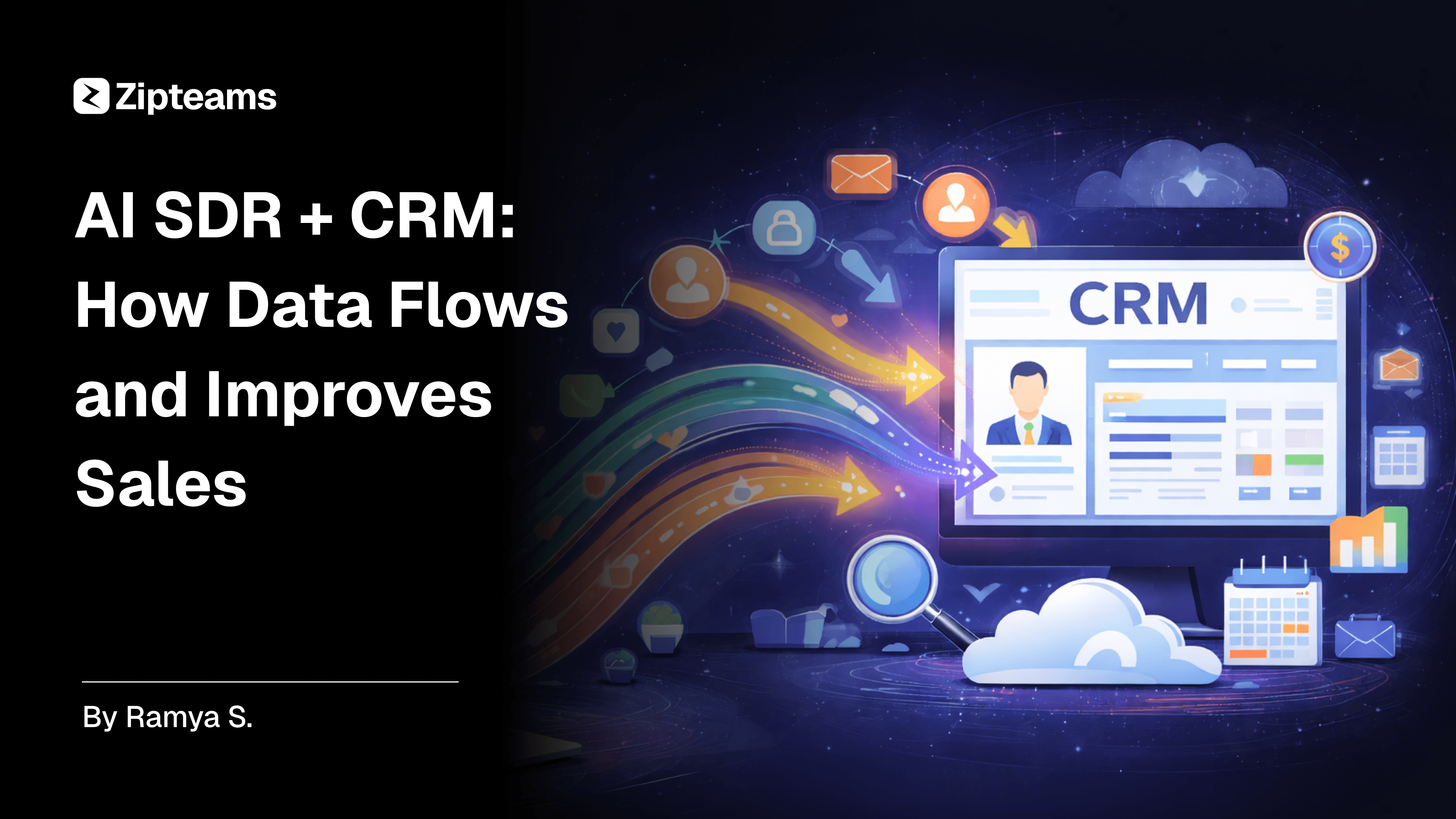
When integrated, they form a continuous data loop that drives the entire revenue engine.
Understanding the Data Flow: From Conversation to Revenue
To truly understand how this improves sales, you need to follow the lifecycle of a lead — not just at a surface level, but at a systems level.
Stage 1: Real-Time Data Capture Through Conversation
When a visitor lands on your website, traditional systems rely on forms.
AI SDRs replace this with conversation.
This shift is important because conversations naturally extract richer, more contextual data.
Instead of just collecting:
Name
Email
The system captures:
Intent (“What are you looking for?”)
Context (“What problem are you solving?”)
Urgency (“When are you planning to act?”)
This is not just data — it is decision-making context.
The quality of data captured at this stage determines everything downstream.
Stage 2: Structuring and Standardizing Data
Raw conversation data is not immediately useful unless it is structured.
Modern AI SDR systems convert free-flowing responses into structured attributes such as:
Lead qualification scores
Industry classification
Use case categories
Buying stage indicators
This step is critical because sales systems depend on standardized data formats.
Without this transformation:
Insights remain buried in conversations
Automation becomes impossible
Structure turns conversation into intelligence.
Stage 3: Instant Synchronization with CRM
The next step is where most traditional systems fail — speed of data transfer.
In manual processes:
Data entry is delayed
Information is incomplete
Errors are common
With AI SDR + CRM integration:
Data is synced instantly
Conversations are logged automatically
Lead profiles are created in real time
This means that the moment a conversation happens, the CRM is already updated.
Sales teams are no longer reacting to leads — they are working with live data.
Stage 4: Context-Rich Sales Engagement
When a sales rep opens the CRM, they don’t just see a contact.
They see:
Full conversation history
Qualification answers
Intent signals
Behavioral context
This fundamentally changes how sales conversations start.
Instead of asking:
“Can you tell me what you’re looking for?”
They can say:
“I saw you’re exploring [specific use case] — let’s go deeper into that.”
This reduces friction, builds trust faster, and shortens sales cycles.
Stage 5: Feedback Loop and Continuous Improvement
One of the most powerful aspects of this system is the feedback loop.
Once deals progress or close:
CRM data reflects outcomes
AI SDR systems analyze patterns
Qualification logic improves
Systems powered by models like ChatGPT can continuously refine:
Questions asked
Lead scoring accuracy
Conversation paths
Over time, the system becomes smarter, not just automated.
Original Data Benchmarks (Industry Patterns)
Across B2B SaaS implementations, the combination of AI SDR + CRM typically results in:
30–50% faster lead response times
20–40% improvement in qualification accuracy
25–60% increase in meeting conversion rates
15–35% increase in pipeline velocity
These are directional benchmarks observed across modern AI-enabled sales teams.
The biggest gains come from eliminating delays and improving data quality simultaneously.
How This Translates Into Real Revenue Impact
The benefits are not just operational — they directly affect revenue outcomes.
Faster Sales Cycles
When sales reps start with context:
Discovery is faster
Conversations are more relevant
Decisions happen sooner
Higher Conversion Rates
Better-qualified leads and stronger context lead to:
More meaningful conversations
Higher trust
Better close rates
Improved Sales Efficiency
Sales teams spend less time on:
Data entry
Unqualified leads
Repetitive questioning
And more time on:
High-value interactions
Closing deals
Better Forecasting and Visibility
Because data is:
Real-time
Structured
Complete
Revenue leaders gain:
Clear pipeline visibility
More accurate forecasts
Final Takeaway
AI SDR + CRM is not just a technical integration.
It is a system-level upgrade to how sales operates.
It ensures that:
No data is lost
No lead is ignored
No opportunity lacks context
The result is not just efficiency — it’s predictable, scalable revenue growth.
Frequently Asked Questions
How does AI SDR integrate with CRM?
AI SDR systems capture conversation data and sync it in real time with CRM platforms, creating structured, actionable lead records.
Why is CRM critical for AI SDR success?
Without CRM, AI-generated insights cannot be tracked, managed, or converted into pipeline and revenue.
Does AI SDR improve CRM data quality?
Yes. It reduces manual entry, captures richer context, and ensures consistent data formatting.