The Future of Prospecting Is Intent + Timing + Context
This article explains about the future of prospecting.
Ramya S.
Jul 1, 2026
Generative AI
Sales
CRM
Productivity
Generative AI
For decades, sales prospecting followed a predictable formula.
Build a list.
Segment prospects.
Send emails.
Make calls.
Hope someone responds.
While technology made these activities faster, the underlying strategy remained largely the same. Prospecting was treated as a numbers game where success depended on reaching as many people as possible.
Today's buyers behave differently.
They research independently, compare vendors before speaking with sales, revisit websites multiple times, involve several stakeholders, and move between channels throughout the buying journey. By the time they respond to an email or request a demo, much of the decision-making process has already begun.
In this environment, sending more outreach doesn't necessarily create more opportunities.
Understanding who is ready to buy, when they are ready, and why they are evaluating solutions has become far more important.
This is why the future of prospecting isn't defined by larger contact databases or higher email volume.
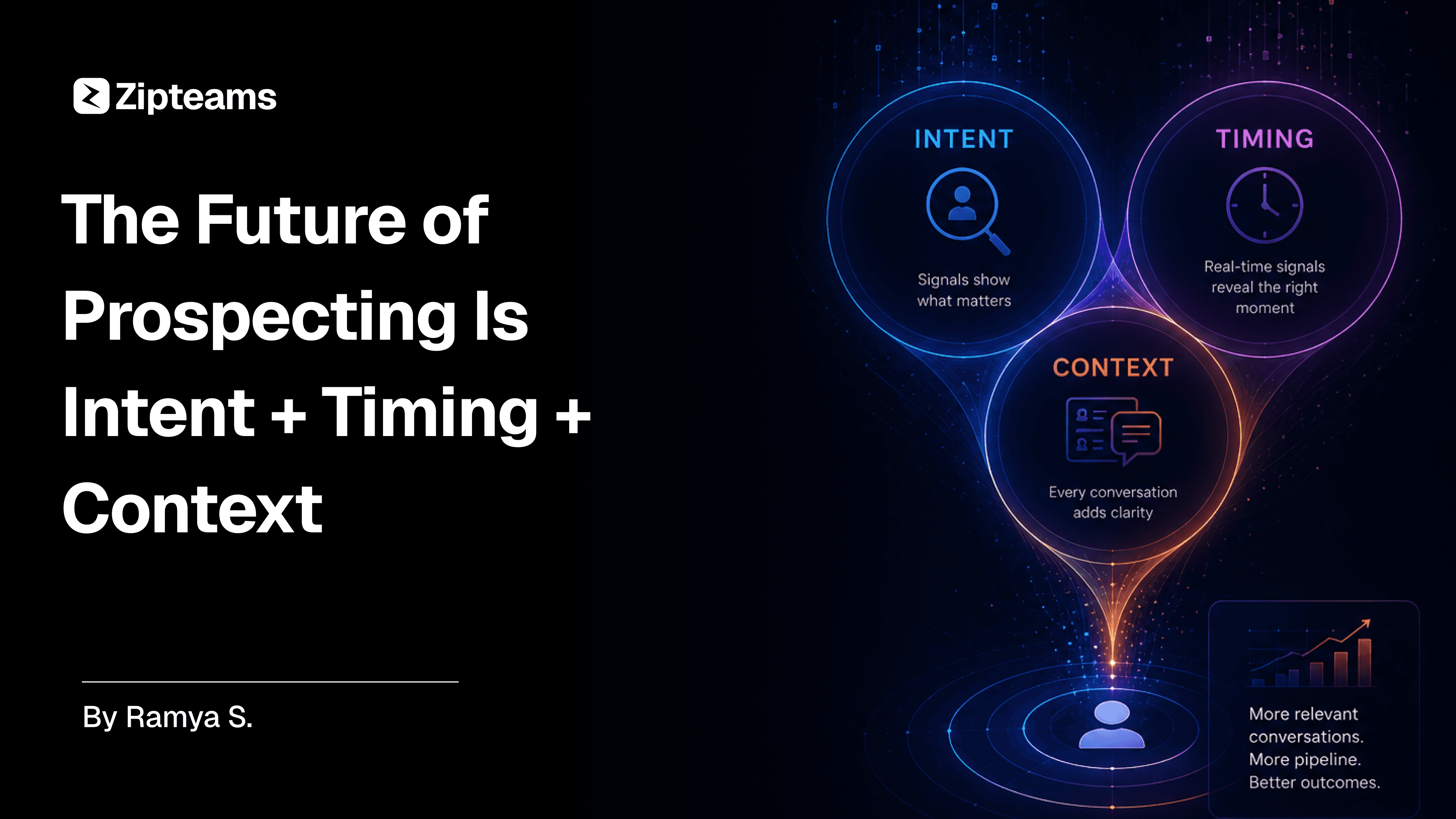
It's defined by Intent, Timing, and Context.
Together, these three factors enable AI SDRs to identify meaningful sales opportunities, prioritize outreach, and engage buyers when conversations are most likely to create value.
Why Traditional Prospecting Is Losing Effectiveness
Traditional prospecting assumes every potential customer deserves similar attention.
Sales teams typically prioritize outreach based on:
Company size
Industry
Job title
Revenue
Geographic location
These characteristics help define an ideal customer profile, but they don't indicate whether someone is actively considering a purchase.
A Vice President at a target company may fit your ICP perfectly but have no current need for your solution.
At the same time, a smaller organization with an immediate business challenge may be far more likely to convert.
The difference lies in intent, timing, and context—not demographics alone.
The Three Pillars of Modern Prospecting
Rather than asking "Who fits our ideal customer profile?", modern revenue teams ask three additional questions:
Are they showing buying intent?
Is this the right time to engage?
Do we understand their context?
Together, these questions form the ITC Framework.
Pillar 1: Intent — Is the Buyer Actively Exploring Solutions?
Intent reflects a prospect's likelihood of making a purchasing decision.
Unlike demographic data, intent focuses on behavior.
Examples include:
Visiting pricing pages.
Comparing vendors.
Asking implementation questions.
Reading customer success stories.
Requesting product documentation.
Engaging with sales conversations.
Returning to the website multiple times.
These actions indicate curiosity that may be developing into purchase intent.
AI SDRs analyze these signals continuously rather than relying on isolated events.
Pillar 2: Timing — Is This the Right Moment?
A qualified prospect isn't always a sales-ready prospect.
Organizations often delay purchasing because of:
Budget cycles.
Existing vendor contracts.
Internal priorities.
Hiring plans.
Product launches.
Procurement processes.
Without understanding timing, sales teams risk reaching out too early—or too late.
AI SDRs monitor changes in buyer behavior over time and adjust engagement accordingly.
Rather than following fixed sequences, they adapt outreach to match the buyer's readiness.
Pillar 3: Context — Why Does This Buyer Need a Solution?
Context explains the circumstances behind buyer behavior.
Two prospects may both request pricing, but for entirely different reasons.
One may be replacing an existing platform after a contract expires.
Another may simply be conducting market research.
AI SDRs combine information such as:
Industry
Company size
Previous conversations
CRM history
Product interests
Stakeholder involvement
Business challenges
Engagement history
This enables more relevant and personalized conversations.
Why Volume Is No Longer a Competitive Advantage
Historically, SDR success was often measured by activity:
Calls made
Emails sent
Meetings booked
While these metrics remain useful, they don't necessarily indicate efficient prospecting.
Modern revenue teams increasingly evaluate:
Response quality
Conversation depth
Pipeline velocity
Sales-qualified opportunities
Revenue generated
This shift rewards meaningful engagement over sheer outreach volume.
AI SDRs help make that transition by prioritizing high-intent opportunities instead of maximizing activity.
AI SDRs Bring Intent, Timing, and Context Together
Each element of the ITC Framework is valuable individually.
The real advantage comes from combining them.
Consider two prospects:
Prospect A
Fits the ideal customer profile.
Opened three emails.
No recent engagement.
No pricing interest.
Last interaction six months ago.
Prospect B
Recently visited the pricing page twice.
Asked about integrations during a website conversation.
Mentioned replacing an existing vendor.
Procurement process begins next quarter.
CTO joined the latest discussion.
Traditional prospecting might prioritize Prospect A because of company size.
AI SDRs recognize that Prospect B demonstrates stronger intent, better timing, and richer context.
Prospecting Becomes Continuous
Prospecting is no longer a one-time activity.
It becomes an ongoing process of monitoring buyer readiness.
As customers interact with:
Website content
Emails
AI chat
Sales representatives
Marketing campaigns
Product documentation
AI continuously updates its understanding of:
Buying intent.
Purchase timeline.
Customer priorities.
Recommended next actions.
This allows revenue teams to respond dynamically instead of relying on static prospect lists.
Better Prospecting Creates Better Qualification
Prospecting and qualification are increasingly interconnected.
When AI understands intent, timing, and context before the first sales conversation, qualification becomes faster and more accurate.
Sales representatives can focus less on collecting basic information and more on exploring business challenges, evaluating fit, and building relationships.
Human SDRs Become Strategic Advisors
AI SDRs don't eliminate the need for human prospecting.
Instead, they change its focus.
Rather than spending hours identifying potential buyers, human SDRs receive prioritized opportunities supported by customer context and recommended next actions.
This allows them to invest more time in:
Complex discovery.
Executive conversations.
Relationship building.
Strategic account planning.
Multi-stakeholder engagement.
AI handles continuous monitoring.
Humans handle meaningful conversations.
Building an Intent-Driven Prospecting Strategy
Organizations adopting AI-driven prospecting should consider:
Monitoring buying signals across multiple channels.
Combining CRM data with conversation intelligence.
Continuously updating customer context.
Identifying engagement patterns rather than isolated actions.
Prioritizing opportunities based on intent and timing.
Reviewing prospect readiness instead of relying solely on lead scores.
The objective isn't simply finding more prospects.
It's identifying the right prospects at the right moment.
The Future of Prospecting Is Predictive
The next generation of prospecting won't depend on larger contact databases or increasingly complex outreach sequences.
It will depend on understanding buyer behavior before opportunities become obvious.
AI SDRs will move beyond reacting to inbound requests.
They'll identify emerging intent, recognize shifts in customer readiness, and recommend engagement when conversations are most likely to succeed.
Prospecting becomes less about finding leads and more about recognizing opportunities as they develop.
Frequently Asked Questions
What is AI-powered prospecting?
AI-powered prospecting uses artificial intelligence to identify potential buyers by analyzing buying signals, customer behavior, conversation insights, and engagement patterns rather than relying solely on static contact lists.
Why are intent, timing, and context important in prospecting?
Together, these three factors provide a more accurate understanding of whether a prospect is ready to engage. They help sales teams prioritize outreach based on actual buying readiness rather than demographic fit alone.
How do AI SDRs improve prospecting?
AI SDRs continuously monitor customer interactions, detect buying signals, analyze conversations, and update prospect context. This enables more personalized outreach and better lead prioritization.
Is traditional prospecting becoming obsolete?
Traditional prospecting techniques still have value, but they are increasingly enhanced by AI. Modern sales organizations combine outbound efforts with real-time intent detection, customer context, and adaptive engagement strategies.
What is the ITC Framework?
The ITC Framework stands for Intent, Timing, and Context. It is a modern approach to sales prospecting that evaluates not just who a prospect is, but whether they are ready to buy, when they are most likely to engage, and what business circumstances influence their decision.
Conclusion
The future of prospecting is no longer defined by the size of a contact database or the number of emails sent each day. As buyer journeys become more complex, successful revenue teams must understand not only who their prospects are, but also why they are evaluating solutions and when they are most likely to engage.
The Intent, Timing, and Context framework reflects this shift. By combining behavioral signals, customer context, and real-time engagement data, AI SDRs help organizations identify opportunities that traditional prospecting methods often overlook.
As AI continues to evolve, prospecting will become increasingly predictive rather than reactive. Sales teams that embrace this approach will spend less time searching for prospects and more time building meaningful conversations with buyers who are genuinely ready to move forward.
