Start your first month free! Get 5,000 credits to put ZIP to work.
Sign up free
AI SDR vs. Sales Engagement Platforms (Outreach, SalesLoft): What's the Difference?
AI SDR vs sales engagement platforms like Outreach and Salesloft: understand the differences in automation, personalization, prospecting, autonomy, and sales execution.
Ramya S.
Generative AI
Sales
Generative AI
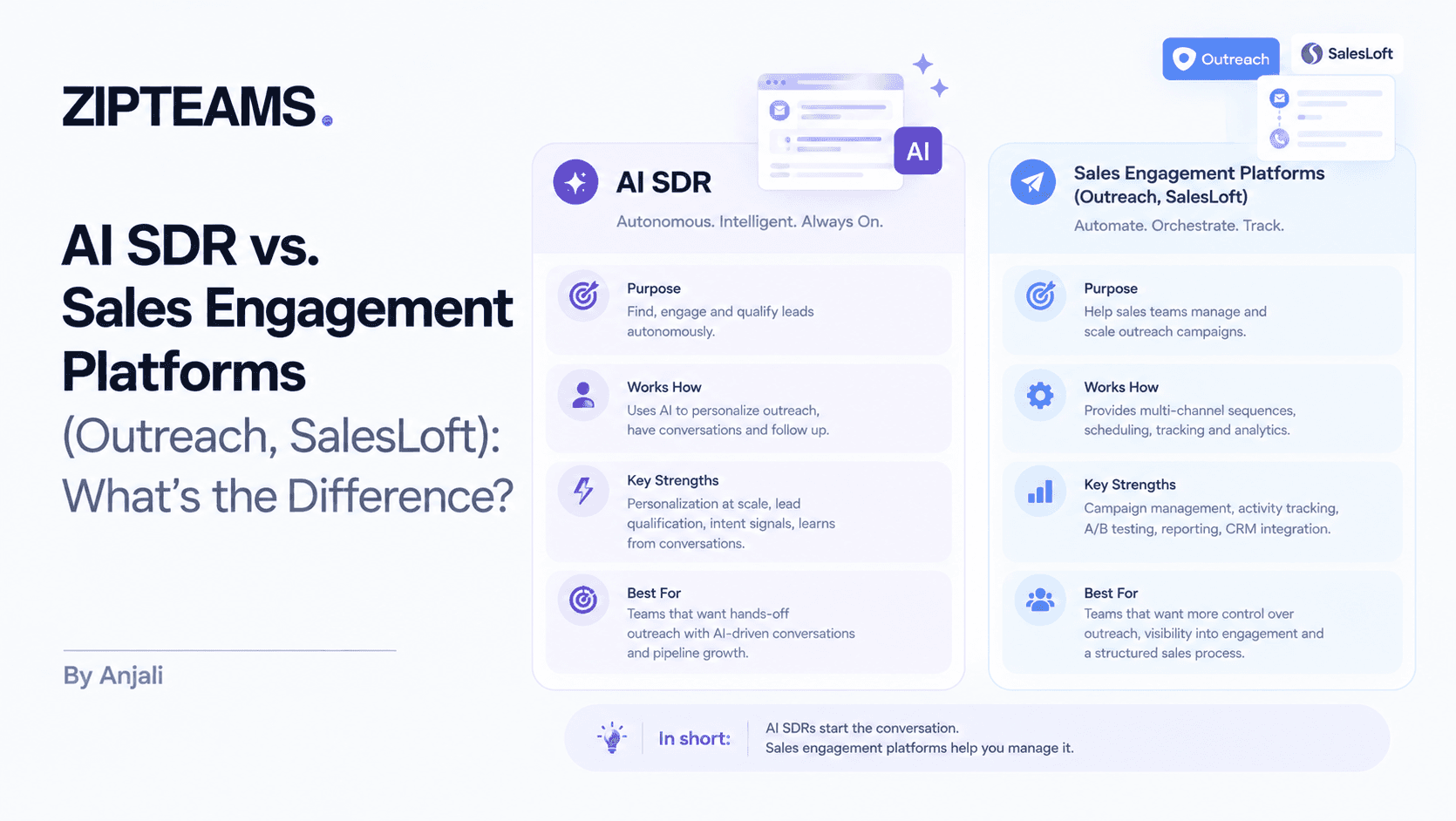
Sales teams have used sales engagement platforms for years to automate prospecting.
A rep loads prospects into a sequence, defines when emails and calls should happen, and the platform helps execute the workflow.
Now AI SDRs are changing that model.
Instead of simply automating steps that a salesperson has already designed, an AI SDR can potentially research prospects, decide who to contact, generate the message, respond to buyers, qualify conversations, follow up, and hand qualified opportunities to a human.
That sounds like a simple distinction:
Sales engagement platform = automation.
AI SDR = autonomous selling.
But the reality in 2026 is more complicated.
Platforms such as Outreach and Salesloft have added AI agents, research capabilities, prioritization, personalization, and other forms of intelligent automation. Outreach, for example, now offers AI agents for research, personalization, revenue workflows, and other sales activities.
Salesloft similarly combines Cadence-based engagement with AI agents that research accounts, identify buyers, prioritize prospects, and generate personalized emails.
So the real question is no longer:
“Does the platform use AI?”
The better question is:
“What does the AI actually do, and how much of the sales process can it own?”
What Is a Sales Engagement Platform?
A sales engagement platform is software that helps sales teams plan, automate, execute, and measure buyer engagement.
The traditional model is built around structured workflows such as:
Select a group of prospects.
Add them to a sequence or cadence.
Define the steps.
Set the timing.
Personalize the messaging.
Let the platform execute the steps.
Notify the salesperson when human action is required.
Track engagement and outcomes.
Outreach describes its Sales Engagement product around sequences, templates, triggers, rulesets, schedules, email, voice, SMS, calendar, and tasks.
Salesloft's Cadence product similarly provides structured, multi-touch engagement across channels, while helping sellers prioritize prospects and automate repetitive work.
The fundamental idea is:
The sales team defines the workflow. The platform helps execute it consistently.
This is extremely useful when a company already has a sales process that it wants to standardize.
What Is an AI SDR?
An AI SDR is an AI-powered sales agent designed to perform some or all of the work traditionally handled by a sales development representative.
Instead of simply executing a predefined sequence, an AI SDR can operate around a goal.
For example:
Goal: Identify qualified prospects and book meetings with companies that match the ICP.
The AI SDR may then:
Research the account
Understand the prospect's role
Review CRM information
Analyze previous conversations
Identify buying signals
Decide whether the lead should be contacted
Generate an appropriate message
Choose the next action
Send the message
Interpret the response
Answer questions
Handle objections
Qualify the prospect
Follow up later
Stop outreach when appropriate
Book a meeting
Update the CRM
Escalate the conversation to a human
The important difference is decision-making.
A traditional sales engagement workflow generally tells the system:
“Do X, then Y, then Z.”
An AI SDR is closer to:
“Achieve X, while following these rules.”
That shift from task automation to goal-oriented execution is what makes AI SDRs different.
AI SDR vs. Sales Engagement Platform: The Core Difference
The easiest way to understand the difference is to look at what controls the workflow.
With a traditional sales engagement workflow:
Human → defines workflow → platform executes workflow → human handles exceptions
With an AI SDR:
Human → defines goal + context + guardrails → AI decides actions → AI executes → human handles escalations
The distinction isn't that one uses AI and the other doesn't.
Modern sales engagement platforms increasingly use AI themselves.
The distinction is how much responsibility the system has for deciding and executing the work.
1. Workflow: Sequences vs. Goals
This is one of the biggest differences.
A sales engagement platform traditionally starts with a sequence or cadence.
For example:
Day 1: Send email
Day 3: Call
Day 5: Send LinkedIn message
Day 8: Send follow-up email
Day 12: Call again
The workflow is predetermined.
An AI SDR can instead start with a goal:
“Qualify inbound leads that match our ICP and book meetings with high-intent prospects.”
The agent can determine what should happen next based on what it learns.
A prospect replies:
“We're interested, but we're currently evaluating this for next quarter.”
A rigid sequence may continue according to its predefined schedule.
An AI SDR can recognize that the buyer is interested but not ready and change the follow-up strategy.
That could mean:
Asking about the evaluation timeline
Capturing the expected buying window
Sharing relevant information
Reducing follow-up frequency
Creating a future follow-up task
Routing the conversation to the appropriate salesperson
The difference is workflow flexibility.
2. Automation vs. Autonomous Execution
Sales engagement platforms are excellent at automating repetitive tasks.
For example:
Sending emails
Creating tasks
Scheduling calls
Moving prospects between steps
Triggering workflows
Tracking engagement
Logging activities
Outreach's Sales Engagement platform includes sequences, triggers, rulesets, schedules, email, voice, SMS, meetings, and tasks.
Salesloft's Cadence similarly provides structured multi-channel engagement and workflow automation.
AI SDRs push further toward autonomous execution.
The system can potentially decide:
Who should be contacted
Why they should be contacted
What should be said
Which channel makes sense
Whether the prospect is qualified
What the response means
What should happen next
That doesn't mean every AI SDR does all of these things.
The important distinction is the degree of autonomy.
3. Personalization: Variables vs. Context
Sales engagement platforms have supported personalization for a long time.
A traditional email might contain:
Hi {{First Name}},
I noticed you're leading {{Department}} at {{Company}}...
This is useful, but it is primarily field-based personalization.
Modern platforms have gone much further.
Salesloft, for example, uses AI agents to research accounts and buyers and generate personalized content using buyer information.
Outreach also provides AI-powered personalization and research capabilities.
An AI SDR can take personalization another step by considering the conversation and business context.
For example:
The CRM says:
Lead source: Webinar
But the conversation says:
“We're currently struggling with follow-up because our inbound volume has doubled.”
That second piece of information may be much more useful for the next message.
Instead of simply inserting CRM fields, the AI SDR can potentially use:
Previous conversations
Buyer intent
Objections
Lead source
Website activity
Company information
Role
Industry
Previous outreach
Buying timeline
Product interest
Qualification responses
This creates a shift from:
Personalized messages
to:
Context-aware conversations.
4. Lead Prioritization: Rules vs. Signals
Sales engagement platforms can prioritize prospects using engagement and other signals.
Salesloft, for example, uses AI-powered prioritization through Rhythm to help sellers focus on relevant actions and buyer signals.
This can answer:
“Which prospect should the salesperson work on next?”
An AI SDR can take the next step:
“Which prospect should I engage next, and what should I do with them?”
That distinction matters.
Imagine 1,000 leads enter the CRM.
A prioritization system might identify the 100 highest-priority leads.
An AI SDR could potentially:
Identify the high-fit accounts.
Detect buying signals.
Research the relevant stakeholders.
Initiate outreach.
Interpret responses.
Qualify interested buyers.
Continue nurturing lower-intent leads.
Escalate qualified opportunities.
The system isn't simply prioritizing human work.
It is potentially performing the work.
5. Conversation Handling
This is where the difference becomes particularly visible.
A sales engagement platform is primarily designed to manage engagement workflows.
An AI SDR is designed to participate in the conversation itself.
Consider a prospect responding:
“Can you integrate with Salesforce?”
A sequence-based system may stop the sequence or create a task for the salesperson.
An AI SDR with the appropriate product knowledge could potentially:
Answer the question
Explain the integration
Ask a relevant qualification question
Detect buying intent
Continue the conversation
Offer to schedule a meeting
The AI is no longer just sending the next message.
It is interpreting the buyer's response and deciding what happens next.
6. Follow-Ups: Fixed Timing vs. Adaptive Timing
Traditional sequences are built around predefined delays.
For example:
Wait 2 days → email
Wait 3 days → call
Wait 4 days → email
This works well when the prospect's behavior is relatively predictable.
But buyers don't behave according to sequences.
A prospect may:
Open several emails
Visit your pricing page
Reply with a question
Go silent
Return three weeks later
Forward an email internally
Say they're interested but not ready
An AI SDR can potentially change its behavior based on those signals.
Instead of:
“Send follow-up #4 because it's day 8.”
The logic becomes:
“The prospect showed interest but isn't ready to buy. Continue nurturing and follow up closer to their stated evaluation date.”
That is adaptive engagement rather than sequence execution.
7. CRM Data: Record Keeping vs. Decision Context
CRM systems traditionally answer:
“What do we know about this customer?”
Sales engagement platforms answer:
“What should the salesperson do next?”
AI SDRs can increasingly use CRM information as decision-making context.
For example:
CRM:
Lead is from an enterprise account.
Conversation history:
Prospect previously mentioned a need for multi-team reporting.
Website activity:
Multiple visits to the analytics page.
Previous objection:
Concern about implementation effort.
An AI SDR can combine these signals to determine that the next interaction should address implementation rather than simply sending another generic product email.
This is where the quality of the context layer becomes critical.
8. Human-in-the-Loop vs. AI-in-the-Loop
Sales engagement platforms are generally built around human sellers.
The software makes the salesperson more productive.
The salesperson still:
Reviews prospects
Writes or approves messaging
Makes calls
Handles replies
Qualifies opportunities
Decides what to do next
AI SDRs change the operating model.
The human may instead:
Define the ICP
Configure the agent
Provide product knowledge
Set qualification criteria
Define guardrails
Review conversations
Handle escalations
Monitor outcomes
Improve the agent
The human becomes less of a task executor and more of an AI supervisor.
This doesn't eliminate salespeople.
It changes where their time is spent.
Are Outreach and Salesloft Still Just Sales Engagement Platforms?
No.
This is an important distinction when comparing today's products.
Both Outreach and Salesloft have expanded beyond traditional sequence automation.
Outreach
Outreach currently offers AI agents for activities including account and prospect research, personalization, revenue workflows, and other sales processes. Its Agent Studio also provides prebuilt AI workflows for sales motions such as researching new prospects and routing prospects into sequences based on research.
Outreach's newer capabilities also allow AI agents to take actions within sales workflows, rather than only retrieve information.
Salesloft
Salesloft combines Cadence-based sales engagement with AI agents for account research, buyer identification, personalized emails, prioritization, and other revenue workflows.
Its platform has increasingly positioned AI agents as part of a broader revenue orchestration system rather than simply a sequence tool.
So the comparison isn't:
Old Salesloft/Outreach vs. AI SDRs.
It is:
Structured sales engagement + AI capabilities vs. an AI-native sales execution model.
That is a much more useful way to evaluate the category.
Where Sales Engagement Platforms Still Fit
Sales engagement platforms are particularly useful when the organization wants structured, repeatable sales execution.
For example:
Standardized outbound
A sales team may have a proven 10-step outbound process.
The platform ensures every rep follows it.
Rep-led prospecting
The salesperson decides who to contact and personally manages the relationship.
The platform reduces administrative work.
Multi-channel execution
Email, calling, SMS, social touches, tasks, and meetings can be managed from a single workflow.
Sales process governance
Sales leaders can define:
Cadences
Messaging
Rules
Timing
Activity expectations
Reporting
This structure can be valuable for larger sales teams where consistency matters.
Where AI SDRs Fit
AI SDRs become more interesting when the goal is to delegate parts of the sales development process, rather than simply automate them.
For example:
High-volume lead qualification
An AI SDR can engage incoming leads and determine which ones meet qualification criteria.
Lead follow-up
Instead of relying on reps to remember every follow-up, the AI can maintain the conversation.
Lead nurturing
Buyers who aren't ready today can remain engaged without consuming SDR capacity.
Conversation-based qualification
The AI can ask questions dynamically instead of relying entirely on a fixed form.
After-hours engagement
An AI SDR can respond when human SDRs aren't available.
CRM-triggered outreach
Events such as new leads, product interest, or changes in account status can trigger AI-driven workflows.
The common thread is:
The AI isn't just executing a workflow. It is participating in the workflow.
AI SDR vs. Sales Engagement Platform: Think in Layers
The most useful way to think about the two categories is not as mutually exclusive products.
Think of the sales stack as layers.
Layer 1: Data
Who is the prospect?
What company are they from?
What do we know about them?
Layer 2: Intelligence
Is this account a good fit?
Is there buying intent?
Who should we contact?
What matters to this buyer?
Layer 3: Engagement
Should we email, call, message, or wait?
What should we say?
When should we say it?
Layer 4: Execution
Who actually performs the action?
A salesperson?
An automated workflow?
An AI agent?
Layer 5: Conversation
What happens after the buyer responds?
Does the system simply create a task?
Or can it continue the conversation?
Layer 6: Outcome
Was the lead qualified?
Was a meeting booked?
Was an opportunity created?
What did the AI learn from the interaction?
Traditional sales engagement platforms have historically been strongest around engagement and execution workflows.
AI SDRs attempt to move further up the stack into intelligence, decision-making, conversation, and autonomous execution.
Modern platforms increasingly cover multiple layers, which is why the categories now overlap.
The Biggest Difference: Who Owns the Next Action?
This may be the simplest way to understand the difference.
With a traditional workflow:
The system tells the salesperson what to do next.
With an AI SDR:
The system can potentially decide and perform the next action itself.
Consider a prospect who says:
“Interested, but we're not planning to buy until Q1.”
A sales engagement platform may:
Pause the sequence
Create a task
Schedule a future step
Notify the rep
An AI SDR could potentially:
Understand the buying timeline
Ask an appropriate follow-up question
Record the expected timing
Change the nurture strategy
Follow up closer to Q1
Continue the conversation
Escalate when buying intent increases
The difference is not simply automation.
It is ownership of the next action.
Do AI SDRs Replace Sales Engagement Platforms?
Not necessarily.
In many organizations, the two can coexist.
A company could use:
CRM → Sales Engagement Platform → AI SDR → Human Salesperson
For example:
CRM stores customer and account information.
Sales engagement platform manages structured outreach.
AI SDR handles qualification and conversations.
Human salesperson takes over when the opportunity becomes valuable or complex.
The more important question is:
Which layer should be responsible for which part of your sales process?
If your sales team already has a mature outbound process, adding AI to the existing workflow may make sense.
If the problem is that thousands of leads require conversations that humans don't have capacity to handle, an AI SDR may address a different problem.
How to Decide Which Model You Need
Start with the problem rather than the technology.
Choose a sales engagement approach when:
Your reps should own most conversations.
Your sales process is highly structured.
You need standardized cadences.
Your main problem is sales productivity.
You want to automate repetitive activities.
Human approval is required for most outreach.
You need strong workflow and activity management.
Consider an AI SDR approach when:
Lead volume exceeds SDR capacity.
Leads require continuous follow-up.
Qualification consumes significant SDR time.
Conversations need to adapt to buyer responses.
You want 24/7 engagement.
You want AI to handle first-level questions.
You want agents to qualify before involving salespeople.
Your sales team wants to supervise AI rather than execute every task manually.
And increasingly, the answer may be both.
The Future Is Moving From Sequences to Sales Agents
The evolution of sales technology can be viewed as a progression.
CRM
Store the customer record.
↓
Sales engagement
Automate the workflow.
↓
AI-assisted engagement
Help the salesperson research and personalize.
↓
AI agents
Perform specific sales tasks.
↓
AI SDRs
Own larger parts of the prospecting and qualification process.
The important shift is from:
“Automate my sales process.”
to:
“Give an AI agent a sales goal and let it execute within defined boundaries.”
That doesn't mean every sales activity should become autonomous.
Some interactions require human judgment, negotiation, relationship building, or domain expertise.
The opportunity is to determine where autonomy creates value and where humans should remain in control.
What Makes an AI SDR Actually Useful?
Calling something an “AI SDR” doesn't automatically make it autonomous or effective.
A useful AI SDR needs more than an LLM generating emails.
It needs context.
That context can include:
CRM records
Account information
Buyer personas
Previous conversations
Product knowledge
Qualification criteria
Buying signals
Objections
Sales policies
Pricing rules
Communication preferences
Human feedback
Previous outcomes
It also needs guardrails.
For example:
Don't contact existing customers.
Don't claim a feature unless it exists in the knowledge base.
Don't offer discounts.
Escalate enterprise opportunities above a certain threshold.
Stop outreach when a prospect opts out.
The result is an agent that operates within a defined sales system, rather than an AI model operating without context.
The Real Comparison Isn't AI SDR vs. AI
This is perhaps the most important takeaway.
Sales engagement platforms are not becoming obsolete simply because AI SDRs exist.
And AI SDRs aren't simply “better versions” of sales engagement software.
They solve overlapping but different problems.
A sales engagement platform is fundamentally about organizing and executing sales engagement workflows.
An AI SDR is fundamentally about delegating sales development work to an AI agent.
Modern platforms such as Outreach and Salesloft increasingly combine both approaches, which means buyers should evaluate the actual workflow rather than the product category or marketing terminology.
The questions to ask are:
Who decides which lead to contact?
Who creates the message?
Who decides when to follow up?
Who interprets the response?
Who qualifies the lead?
Who handles objections?
Who updates the CRM?
Who decides when to escalate?
How much human approval is required?
What context does the system use?
What happens when the buyer behaves differently from the expected sequence?
Those questions reveal the real difference between automation software and an autonomous sales agent.
AI SDR vs. Sales Engagement Platform: The Bottom Line
The simplest distinction is this:
Sales engagement platforms help salespeople execute a sales process.
AI SDRs aim to execute parts of the sales process on behalf of salespeople.
But the categories are converging.
Outreach and Salesloft now include AI agents, intelligent prioritization, research, personalization, and increasingly autonomous workflows.
So the future isn't necessarily about choosing between “sales engagement” and “AI.”
It's about deciding which parts of your sales process should be automated, assisted, or delegated to AI.
For a sales team, that distinction matters far more than the label on the software.
Frequently Asked Questions
Is an AI SDR the same as a sales engagement platform?
No. A sales engagement platform primarily organizes and automates sales workflows such as sequences, calls, emails, tasks, and follow-ups. An AI SDR is designed to perform a broader set of SDR activities, potentially including research, outreach, qualification, conversation handling, and adaptive follow-up.
However, modern sales engagement platforms increasingly include AI agents, so there is significant overlap.
Is Outreach an AI SDR?
Outreach is a broader sales execution and engagement platform that now includes AI agents. Its capabilities include sales engagement workflows as well as AI-powered research, personalization, revenue workflows, and agent-based automation.
Whether a particular Outreach workflow functions like an AI SDR depends on which capabilities and agents are configured.
Is Salesloft an AI SDR?
Salesloft is a broader revenue orchestration and sales engagement platform that includes Cadence plus AI agents for activities such as account research, buyer identification, personalization, prioritization, and other revenue workflows.
It is therefore more accurate to view Salesloft as a platform that incorporates AI-agent capabilities rather than simply calling the entire platform an AI SDR.
Can an AI SDR work with Outreach or Salesloft?
Yes, depending on the integration and architecture.
An organization could use a sales engagement platform for structured workflows while an AI SDR handles specific activities such as lead qualification, conversational follow-up, or other delegated tasks.
The key is to define which system owns each action and how data flows between them.
What is the biggest difference between an AI SDR and a sales cadence?
A cadence is a predefined sequence of actions.
An AI SDR can potentially determine which action should happen next based on the prospect's context and response.
A cadence says:
“Send this email after three days.”
An AI SDR can work toward:
“Continue the conversation and qualify the buyer.”
Do AI SDRs eliminate the need for SDRs?
Not necessarily.
AI SDRs can automate repetitive prospecting and qualification work, but human salespeople remain important for complex conversations, relationship building, negotiation, strategic accounts, and opportunities that require human judgment.
The role of an SDR can shift from executing every outreach task to managing higher-value conversations and supervising AI-driven prospecting.
Which is better: an AI SDR or a sales engagement platform?
There isn't one answer for every sales team.
The right choice depends on the workflow you want to automate.
If the primary need is structured, rep-led outreach, sales engagement software can provide the workflow infrastructure.
If the primary need is delegating qualification, follow-up, and conversational sales development to an AI agent, an AI SDR may be more appropriate.
Many modern sales organizations will use both.
Conclusion
The difference between AI SDRs and sales engagement platforms is no longer simply AI vs. automation.
Sales engagement platforms are evolving to include AI agents, while AI SDRs are expanding from simple automated outreach into broader sales execution.
The more useful distinction is who owns the work.
A sales engagement platform can help a salesperson execute a defined process.
An AI SDR can potentially own a goal, make decisions within guardrails, interact with prospects, and execute multiple steps toward that goal.
That shift—from automating tasks to delegating sales outcomes—is what makes AI SDRs fundamentally interesting.
And it is also why evaluating the technology requires looking beyond features like sequences, AI-generated emails, or personalization.
The real question is:
How much of the sales development workflow can the system understand, decide, and execute on its own?